English
 Język Polski


Jewish Social Self-help During Operation Reinhardt
Aleksandra Bańkowska
olabankowska@interia.pl Author Biographyhistorian, PhD student at the Institute of History of the Polish Academy of Sciences, scientific editor of the volumes of the Ringelblum Archive, incl. Archiwum Ringelbluma. Konspiracyjne Archiwum Getta Warszawy, vol. 11: Ludzie i prace „Oneg Szabat” (2013, together with Tadeusz Epsztein) and vol. 27: Żydowska Samopomoc Społeczna w Warszawie 1939–1943 (2016, together with Maria Ferenc Piotrowska).
 https://orcid.org/0000-0003-1037-0550
Institute of History of the Polish Academy of Sciences
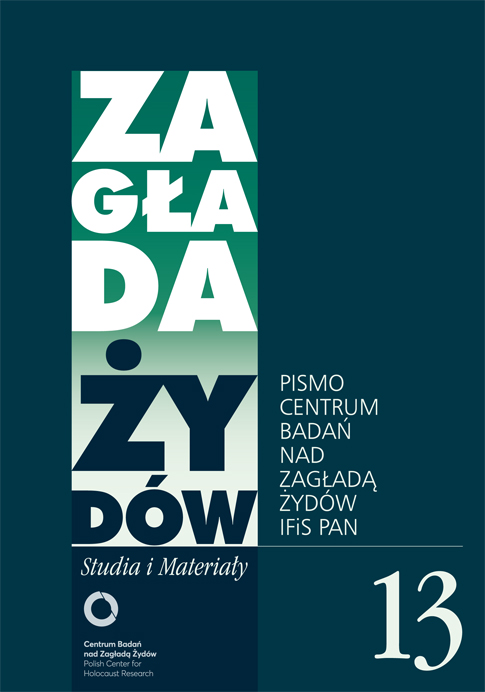
Zagłada Żydów. Studia i Materiały, No. 13 (2017), Pages: 276-294
Submission Date: 2020-10-17Publication Date: 2017-12-03
 https://doi.org/10.32927/ZZSiM.360
Abstract
In 1942 the Jewish Social Self-help (Żydowska Samopomoc Społeczna, ŻSS) was the only central Jewish organization in the General Government, with branches in over 300 localities. From the very beginning of Operation Reinhardt the ŻSS Presidium in Cracow had received official letters from the local branches and letters from private persons containing information about “deportations in an unknown direction,” that is, to death camps. This article analyzes the content and language of that correspondence and describes the actions undertaken by the ŻSS Presidium with regard to the collected information. During the first weeks those were attempts to confirm the transports’ destination and negotiations with the German administration of the General Government regarding provision of decent living conditions in the places of ‘resettlement’. Those efforts were discontinued with the gradual advent of the awareness of the extermination. From then on the Presidium concentrated on protecting its own employees from deportation and increasing their number. Moreover, it also encouraged its local branches to establish work co-operatives for artisans, which was thought to enable the employed to avoid deportation. In the end all those efforts came to no avail. The ŻSS continued its activity, in a significantly reduced dimension, under a changed name (Jüdische Unterstützungstelle, JUS) until July 1944.
License
Copyright (c) 2017 Author&"Holocaust Studies and Materials"

This work is licensed under a Creative Commons Attribution 4.0 International License.
https://creativecommons.org/licenses/by/4.0
The journal is published under the Diamond Open Access Standard, CC-BY-4.0 Deed - Attribution 4.0 International - Creative Commons
Most read articles by the same author(s)
- Aleksandra Bańkowska, Polish Partisan Formations during 1942–1944 in Jewish Testimonies , Zagłada Żydów. Studia i Materiały: 2008: Holocaust Studies and Materials
- Agnieszka Haska, Aleksandra Bańkowska, Post-War Inhabitants of the Building at Tłomackie Street No. 5 , Zagłada Żydów. Studia i Materiały: No. 8 (2012)
- Aleksandra Bańkowska, Polish Partisan Formations during 1942–1944 in Jewish Testimonies , Zagłada Żydów. Studia i Materiały: No. 1 (2005)
- Aleksandra Bańkowska, Weronika Romanik, The Bialystok Ghetto Underground Archive. The Mersik–Tenenbaum Archive , Zagłada Żydów. Studia i Materiały: No. 9 (2013)
- Aleksandra Bańkowska, Agnieszka Haska, (“…buried in the Basements of the Enumerated Buildings Are…” The Search for the Ringelblum Archive , Zagłada Żydów. Studia i Materiały: No. 12 (2016)
- Aleksandra Bańkowska, Between responsibility and powerlessness, generosity and temptation. Social care workers in the Warsaw ghetto in the face of their charges and petitioners , Zagłada Żydów. Studia i Materiały: No. 20 (2024)
- Maria Ferenc, Aleksandra Bańkowska, “Could there be any moral compensation for the obliteration of all traces of a thousand years of Jewish existence in Poland?” Unknown writings by Emanuel Ringelblum from 1943 , Zagłada Żydów. Studia i Materiały: No. 20 (2024)
- Aleksandra Bańkowska, Tatiana Brustin-Berenstein , Zagłada Żydów. Studia i Materiały: No. 7 (2011)
- Aleksandra Bańkowska, Sebastian Piątkowski (oprac.), Relacje o pomocy udzielanej Żydom przez Polaków w latach 1939–1945, t. 1–4 [Aleksandra Bańkowska] , Zagłada Żydów. Studia i Materiały: No. 17 (2021)
- Aleksandra Bańkowska, Jan Láníček, Jan Lambertz (eds.), More than Parcels:Wartime Aid for Jews in Nazi Camps and Ghettos , Zagłada Żydów. Studia i Materiały: No. 19 (2023)
Similar Articles
- Sławomir Jacek Żurek, Lublin: Holocaust and remembrance. An analysis of Tomasz Pietrasiewicz’s Miasto odchodzi (The City is Departing) , Zagłada Żydów. Studia i Materiały: No. 21 (2025)
- Karolina Panz, “Why did they, who had suffered so much and endured, had to die?” The Jewish victims of armed violence in Podhale (1945–1947) , Zagłada Żydów. Studia i Materiały: No. Holocaust Studies and Materials (2017)
- Martyna Grądzka-Rejak, Joanna Sliwa, Jewish Childhood in Kraków: A Microhistory of the Holocaust , Zagłada Żydów. Studia i Materiały: No. 20 (2024)
- Dariusz Libionka, Jacek Leociak, 75th Anniversary of Operation Reinhardt , Zagłada Żydów. Studia i Materiały: No. 13 (2017)
- Marta Witkowska, Michał Bilewicz, Will the Truth Set Us Free?. Breaking the resistance in the education about Holocaust , Zagłada Żydów. Studia i Materiały: No. 10 (2014)
- Kamil Kijek, Are Polish-Jewish Relations the History of Jews in Poland?: Audrey Kichelewski, Ocalali. Żydzi polscy po Zagładzie , Zagłada Żydów. Studia i Materiały: No. 18 (2022)
- Adam Puławski, The Last Mail , Zagłada Żydów. Studia i Materiały: No. 3 (2007)
- Klara Naszkowska, Judith S. Kestenberg and the Escape into the (Non-)Memory of the Holocaust , Zagłada Żydów. Studia i Materiały: No. 18 (2022)
- Karolina Panz, Survival Networks – Smugglers from Podhale and Spiš During the Holocaust , Zagłada Żydów. Studia i Materiały: No. 18 (2022)
- Katarzyna Odrzywołek, Piotr Trojański, Tehran Children – from Siberian Frost to Palestinian Sun. The role of Polish Embassy’s diplomatic posts in the USSR and Anders’s Army in rescuing Jewish children , Zagłada Żydów. Studia i Materiały: No. 11 (2015)
<< < 1 2 3 4 5 6 7 8 9 10 11 12 13 14 15 16 17 18 19 20 21 22 23 24 25 26 27 28 29 30 31 32 33 34 35 36 37 38 39 40 41 42 43 44 45 46 47 48 49 50 > >>
You may also start an advanced similarity search for this article.