English
 Język Polski


Polish Literature on Denouncements and Denouncers
Sławomir Buryła
redakcja@holocaustresearch.pl Author Biographyabsolwent Uniwersytetu Mikołaja Kopernika w Toruniu, adiunkt w Instytucie Filologii Polskiej Uniwersytetu Warmińsko-Mazurskiego w Olsztynie. Autor książki Prawda mitu i literatury, edytor krytycznego wydania dwóch tomów prozy Tadeusza Borowskiego. Ostatnio wydał Opisać Zagładę. Holocaust w twórczości Henryka Grynberga. Zajmuje się literaturą wojny i okupacji, a zwłaszcza problematyką Holocaustu oglądaną m.in. pod kątem obecności w niej pytań o trudne wybory moralne, dobroć Boga, istotę żydowskiej i polskiej pamięci
 https://orcid.org/0000-0001-9838-0467
Institute of Polish Philology, Warmia and Mazury University in Olsztyn
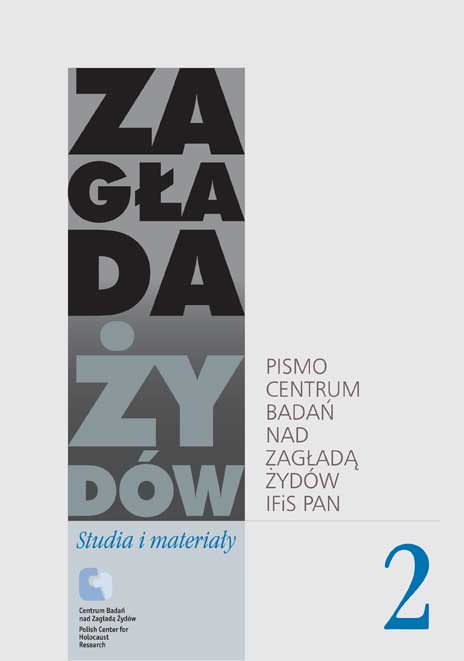
Zagłada Żydów. Studia i Materiały, No. 2 (2006), Pages: 76-98
Submission Date: 2020-10-11Publication Date: 2006-12-02
 https://doi.org/10.32927/ZZSiM.181
Abstract
In this article, the author attempts to present the sensitive issue of denunciation of Jews during the occupation. The analysis is based on Polish sources, supplemented with memoirs and testimonies. The starting point and an important intellectual context is the pioneer book by Barbara Engelking „szanowny panie gistapo” (Dear Mr Gistapo).
Informers, acting anonymously, were therefore often more dangerous than the szmalcownicy (blackmailers) and did not see anything morally reprehensible in their actions. Yet it was one of the most menacing and hideous wartime occupations. The author also verifies the commonly held opinion that this phenomenon was relatively limited. It seems that this was a veritable plague during the occupation, which is reflected in literary texts. The fear of a blackmailer or informer was a feeling known to many Jews in hiding. In line with Barbara Engelking, the author treats denunciation as a form of collaboration, secret co-operation with the Nazis in their atrocious pursuits.
One of the most important issues dealt with in this article is to answer why the Jews were denounced. Among the primary motives are: the desire seize the victim's property, frustration, feelings of superiority and power afforded by the perpetrator's anonymity, but also anti-Semitism and racial hatred.
License
Copyright (c) 2006 Author&"Holocaust Studies and Materials"

This work is licensed under a Creative Commons Attribution 4.0 International License.
https://creativecommons.org/licenses/by/4.0
The journal is published under the Diamond Open Access Standard, CC-BY-4.0 Deed - Attribution 4.0 International - Creative Commons
Most read articles by the same author(s)
Similar Articles
- Gabriel Finder, The Trial of Shepsl Rotholc and the Politics of Retribution in the Aftermath of the Holocaust , Zagłada Żydów. Studia i Materiały: No. 2 (2006)
- Jacek Leociak, Understanding the Holocaust. A Task for Generations , Zagłada Żydów. Studia i Materiały: 2008: Holocaust Studies and Materials
- Karolina Panz, The Destruction of shtetl Grice , Zagłada Żydów. Studia i Materiały: No. 3 (2007)
- Natalia Aleksiun, Historiography of the Holocaust on the Polish-Jewish relations in Poland , Zagłada Żydów. Studia i Materiały: No. 1 (2005)
- Editors Journal, Jan Grabowski, From the editors , Zagłada Żydów. Studia i Materiały: 2010: Holocaust Studies and Materials
- Natalia Aleksiun, When Fajga Left Tadeusz. Wartime Relationships of Survivors after the Holocaust , Zagłada Żydów. Studia i Materiały: No. 17 (2021)
- Małgorzata Melchior, The Holocaust and Polish-Jewish Relations in Sociological Studies , Zagłada Żydów. Studia i Materiały: 2008: Holocaust Studies and Materials
- Justyna Kowalska-Leder, The folk history of the Holocaust and the turn to oral history archives , Zagłada Żydów. Studia i Materiały: No. 21 (2025)
- Jan Grabowski, Editors, From the editor , Zagłada Żydów. Studia i Materiały: 2008: Holocaust Studies and Materials
- Agnieszka Kajczyk, Iwona Kurz, “Typical Image”: The album Extermination of Polish Jewry (1945) , Zagłada Żydów. Studia i Materiały: No. 20 (2024)
1 2 3 4 5 6 7 8 9 10 11 12 13 14 15 16 17 18 19 20 21 22 23 24 25 26 27 28 29 30 31 32 33 34 35 36 37 38 39 40 41 42 43 44 45 46 47 48 49 50 > >>
You may also start an advanced similarity search for this article.