English
 Język Polski


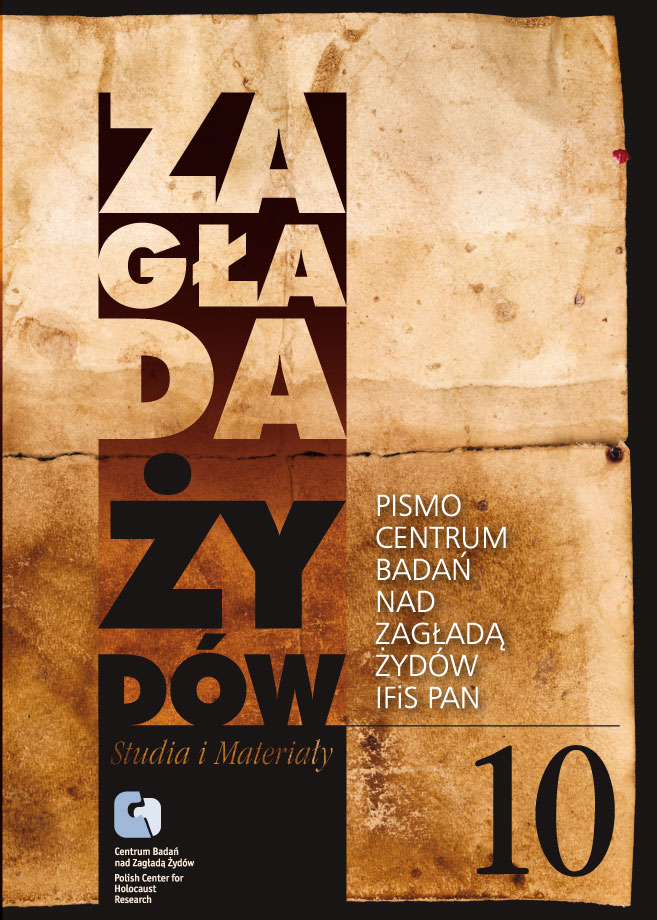
Jewish Council in Warsaw in the Light of Official Documents from Ringelblum’s Archive
Zagłada Żydów. Studia i Materiały, No. 10 (2014), Pages: 131-167
Submission Date: 2020-10-22Publication Date: 2014-12-01
 https://doi.org/10.32927/ZZSiM.519
Abstract
The article bases mostly on the official documents produced by the Warsaw Jewish Council (Judenrat) during 1939–1942 which have survived in the Underground Warsaw Ghetto Archive (Ringelblum’s Archive, ARG). The materials collected by Ringelblum’s collaborators, who obtained them from the Jewish Council’s offices and stored them (mostly in the form of duplicates), do not show the Council only as an institution “caught” red-handed shaping its policy together with the Germans. For the materials also illustrate the Council’s contacts with the ghetto residents and present the internal life of the Council as an institution. The articles focuses only on the documents produced prior to 22 July 1942 (before the deportation campaign) which make it possible to reconstruct the organisation and the policy of that pseudo Jewish local government. Some of the documents provide deep insight into the important spheres of the Council’s activity, so far insufficiently described in literature. The article focuses on only four selected aspects: the Council as an instrument of terror, its charitable activity, its registration of the residents as an example of everyday official-bureaucratic activity, and the internal image of the Council as an institution. Particular attention should be paid to the Council’s documents which demonstrate how the Germans incorporated it into their terror apparatus and how the Council was forced to act as an intermediary in the fiscal oppression of the Jews, in the collection of social insurance fees, in requisitions (particularly in the “Fur Campaign”), in the organisation of popular compulsory labour, and in the establishment of handicraft workshops operating for the occupier. The said issues, illustrated with documents selected by the ARG, show the Warsaw Judenrat’s Janus-like countenance: on the one hand an instrument of German terror, on the other hand a shield doing its best to protect the Jewish community against the German authorities’ ruthlessness.
License
Copyright (c) 2014 Author&"Holocaust Studies and Materials"

This work is licensed under a Creative Commons Attribution 4.0 International License.
https://creativecommons.org/licenses/by/4.0
The journal is published under the Diamond Open Access Standard, CC-BY-4.0 Deed - Attribution 4.0 International - Creative Commons
Most read articles by the same author(s)
- Marta Janczewska, Research on Starvation in the Warsaw Ghetto – Ethical Problems , Zagłada Żydów. Studia i Materiały: No. 5 (2009)
- Marta Janczewska, Research on Starvation in the Warsaw Ghetto – Ethical Problems , Zagłada Żydów. Studia i Materiały: 2010: Holocaust Studies and Materials
- Marta Janczewska, Official Medical Documents as a Source for Research of the Fate of Warsaw Jews 1939–1941 , Zagłada Żydów. Studia i Materiały: No. 9 (2013)
- Marta Janczewska, Death in the German Official Language as Exemplified by Jürgen Stroop’s Report , Zagłada Żydów. Studia i Materiały: No. 12 (2016)
- Marta Janczewska, Jan Jagielski 1937-2021 , Zagłada Żydów. Studia i Materiały: No. 17 (2021)
- Marta Janczewska, Memoirs, testimonies, overviews – a Jewish Historical Institute series INB , Zagłada Żydów. Studia i Materiały: No. 3 (2007)
- Marta Janczewska, The Encyclopedia of the Righteous Among the Nations: Rescuers of Jews during the Holocaust – Poland, Yad-Vashem, Jerusalem 2005 , Zagłada Żydów. Studia i Materiały: No. 1 (2005)
- Marta Janczewska, Jechiel Rajchman, Ocalałem z Treblinki. Wspomnienia z lat 1942–1943, tłum. Bella Szwarcman-Czarnota, oprac., red. i posłowie Ewa Koźmińska-Frejlak, Warszawa: Czytelnik, 2011, 140 s. Richard Glazar, Stacja Treblinka, tłum. przypisy i posłowie Ewa Czerwiako , Zagłada Żydów. Studia i Materiały: No. 7 (2011)
- Marta Janczewska, Jak blisko można podejść do umarłych? , Zagłada Żydów. Studia i Materiały: No. 6 (2010)
- Marta Janczewska, Perec Opoczyński, Reportaże z getta warszawskiego , Zagłada Żydów. Studia i Materiały: No. 5 (2009)
Similar Articles
- Magdalena Semczyszyn, Jews in Soviet Partisan Camps in North-Eastern Terrains of the Second Republic of Poland During 1941‒1944 – Major Issues , Zagłada Żydów. Studia i Materiały: No. 17 (2021)
- Karolina Panz, Survival Networks – Smugglers from Podhale and Spiš During the Holocaust , Zagłada Żydów. Studia i Materiały: No. 18 (2022)
- Nawojka Cieślińska-Lobkowicz, The new Holocaust Museum in Amsterdam , Zagłada Żydów. Studia i Materiały: No. 20 (2024)
- Kula Marcin, Auschwitz as a Social fact , Zagłada Żydów. Studia i Materiały: No. 2 (2006)
- Jan Tomasz Gross, Is the Holocaust their history or ours? , Zagłada Żydów. Studia i Materiały: No. 13 (2017)
- Dagmara Swałtek-Niewińska, Salomon Greiwer and the Municipal Workshops in Bochnia , Zagłada Żydów. Studia i Materiały: No. 12 (2016)
- Dariusz Libionka, Jan Grabowski, Reports of the Praga Area of the Polish Police Regarding Apprehension of Jews in Warsaw during May–July 1943 , Zagłada Żydów. Studia i Materiały: No. 10 (2014)
- Przemysław Nowicki, Łucja Pawlicka-Nowak (1938–2020) – Holocaust Scholar, Precursors of Archeology of Sites of Memory , Zagłada Żydów. Studia i Materiały: No. 16 (2020)
- Caroline Sturdy Colls, Gone but not forgotten: Archaeological Approaches to the Site of the Former Treblinka Extermination Camp in Poland , Zagłada Żydów. Studia i Materiały: No. 8 (2012)
- Andrew Kornbluth, „There Are Many Cains Among Us” [Jest wielu Kainów pośród nas]: Polish Justice and the Holocaust, 1944–1956 , Zagłada Żydów. Studia i Materiały: No. 9 (2013)
<< < 19 20 21 22 23 24 25 26 27 28 29 30 31 32 33 34 35 36 37 38 39 40 41 42 43 44 45 46 47 48 49 50 51 52 53 54 55 56 57 58 59 60 61 62 63 64 65 66 67 68 > >>
You may also start an advanced similarity search for this article.