English
 Język Polski


The Victim’s Voice and Melodramatic Esthetics in History
Amos Goldberg
redakcja@holocaustresearch.pl Author BiographyP.hD. he works at The Hebrew University of Jerusalem. Editor and co-author of 4 volume Years Wherein We Have Seen Evil: Selected Aspects in the History of Religious Jewry During the Holocaust, Yad Vashem 2003–2007
 https://orcid.org/0000-0001-6361-3232
The Hebrew University of Jerusalem
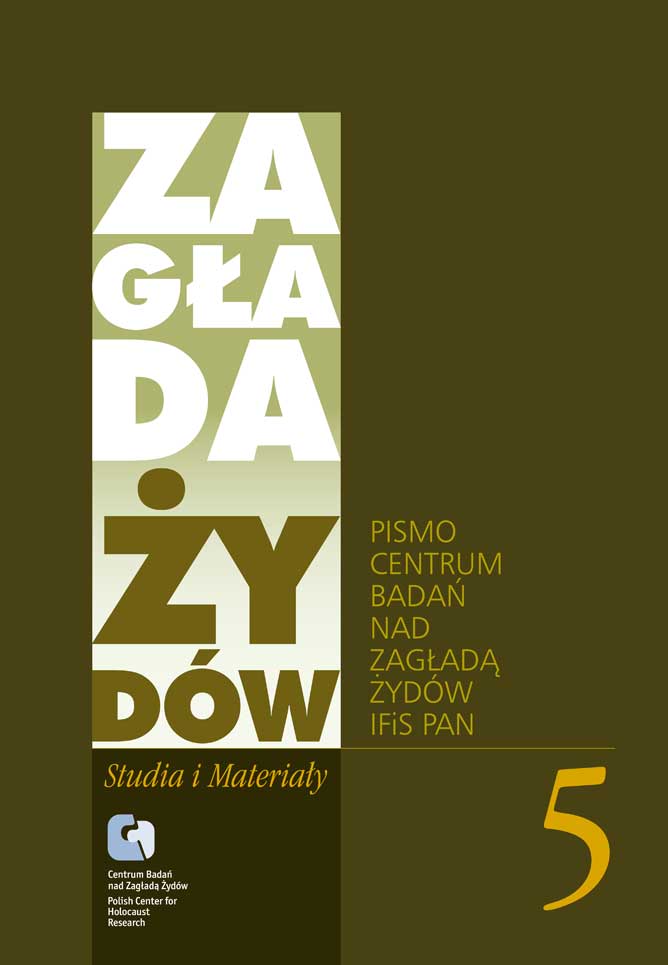
Zagłada Żydów. Studia i Materiały, No. 5 (2009), Pages: 221-240
Submission Date: 2020-10-16Publication Date: 2009-11-09
 https://doi.org/10.32927/ZZSiM.313
Abstract
Saul Friedländer’s recent Nazi Germany and the Jews: The Years of Extermination offers a brilliant new literary mode for historical representation of extreme events such as the Holocaust. The article offers a comparative assessment of Friedländer’s achievement with regard to the integration of Jewish sources into the historical account. It begins with a contextualization of Friedländer’s book within a framework that compares the ways in which Jewish sources are addressed by different historio-graphical approaches. In the second part it seeks to contextualize analytically and critically Friedländer’s concept of „disbelief” – a concept by which he defines the role of the „victims’ voices” in his narrative. The article concludes by briefly suggesting some guidelines for an alternative approach to the study of contemporary Jewish Holocaust sources
Keywords
Holocaust historiography , witness , Saul Friedländer
License
Copyright (c) 2009 Author&"Holocaust Studies and Materials"

This work is licensed under a Creative Commons Attribution 4.0 International License.
https://creativecommons.org/licenses/by/4.0
The journal is published under the Diamond Open Access Standard, CC-BY-4.0 Deed - Attribution 4.0 International - Creative Commons
Most read articles by the same author(s)
- Amos Goldberg, Is There an “Other” in this (Yad Vashem New Holocaust) Museum? , Zagłada Żydów. Studia i Materiały: No. 7 (2011)
Similar Articles
- Klara Jackl, “Is that me...” Henryk Beck’s pictorial memoir of the war and the Holocaust , Zagłada Żydów. Studia i Materiały: No. 20 (2024)
- Marta Tomczok, What is the Holocaust for Today, or Poetic Survival , Zagłada Żydów. Studia i Materiały: No. 17 (2021)
- Martin Dean, Economy of Exploitation: “Living Conditions” in the Ghettos of German-Occupied Eastern Poland , Zagłada Żydów. Studia i Materiały: No. 3 (2007)
- Editors, From the editors , Zagłada Żydów. Studia i Materiały: No. Holocaust Studies and Materials (2017)
- Paweł Dobrosielski, Marek Hłasko’s short story “Szukając gwiazd” [Searching for the stars] as a parable of the Holocaust and a mythical “initial event” in his ) , Zagłada Żydów. Studia i Materiały: No. 4 (2008)
- Maria Ferenc, “Understandably, we are staying put.” He-Chalutz activists faced with the prospect of escaping from occupied Poland , Zagłada Żydów. Studia i Materiały: No. 19 (2023)
- Marta Duch-Dyngosz, In Search of Local Memory of the Holocaust. The Case of Commemoration of Jewish Communities in Smaller Towns in Contemporary Poland , Zagłada Żydów. Studia i Materiały: No. 17 (2021)
- Klara Naszkowska, Judith S. Kestenberg and the Escape into the (Non-)Memory of the Holocaust , Zagłada Żydów. Studia i Materiały: No. 18 (2022)
- Marta Tomczok, The Łódź Ghetto in Contemporary Literature for Children and Young People. Critique of ‘New Sensitivity’ , Zagłada Żydów. Studia i Materiały: No. 16 (2020)
- John Pawlikowski OSM, The Catholic Church and the Holocaust; Institutional Persepectives , Zagłada Żydów. Studia i Materiały: No. 5 (2009)
<< < 1 2 3 4 5 6 7 8 9 10 11 12 13 14 15 16 17 18 19 20 21 22 23 24 25 26 27 28 29 30 31 32 33 34 35 36 37 38 39 40 41 42 43 44 45 46 47 48 49 50 > >>
You may also start an advanced similarity search for this article.