English
 Język Polski


The Victim’s Voice and Melodramatic Esthetics in History
Amos Goldberg
redakcja@holocaustresearch.pl Author BiographyP.hD. he works at The Hebrew University of Jerusalem. Editor and co-author of 4 volume Years Wherein We Have Seen Evil: Selected Aspects in the History of Religious Jewry During the Holocaust, Yad Vashem 2003–2007
 https://orcid.org/0000-0001-6361-3232
The Hebrew University of Jerusalem
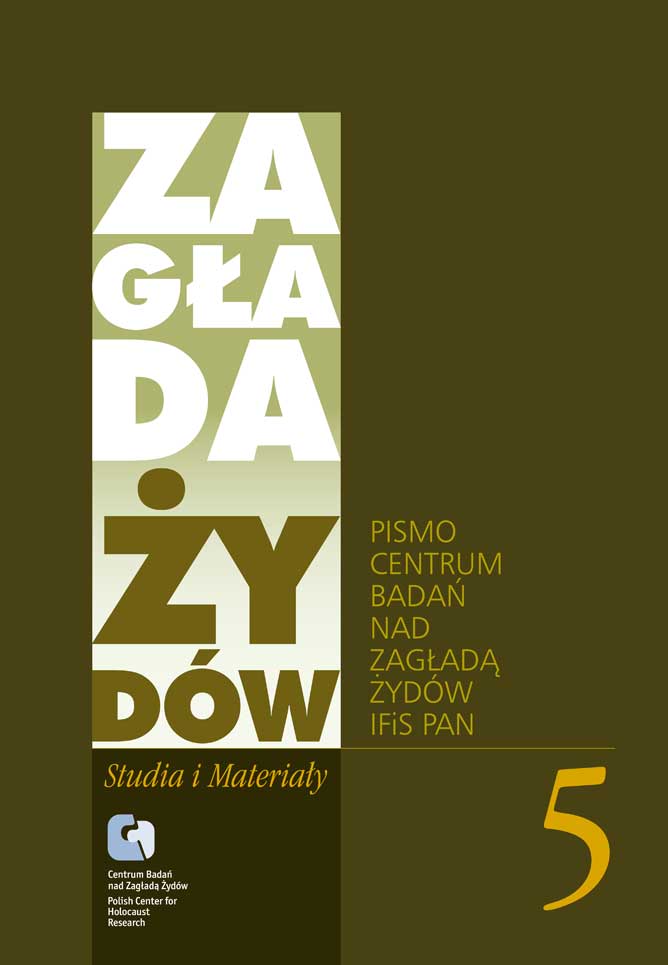
Zagłada Żydów. Studia i Materiały, No. 5 (2009), Pages: 221-240
Submission Date: 2020-10-16Publication Date: 2009-11-09
 https://doi.org/10.32927/ZZSiM.313
Abstract
Saul Friedländer’s recent Nazi Germany and the Jews: The Years of Extermination offers a brilliant new literary mode for historical representation of extreme events such as the Holocaust. The article offers a comparative assessment of Friedländer’s achievement with regard to the integration of Jewish sources into the historical account. It begins with a contextualization of Friedländer’s book within a framework that compares the ways in which Jewish sources are addressed by different historio-graphical approaches. In the second part it seeks to contextualize analytically and critically Friedländer’s concept of „disbelief” – a concept by which he defines the role of the „victims’ voices” in his narrative. The article concludes by briefly suggesting some guidelines for an alternative approach to the study of contemporary Jewish Holocaust sources
Keywords
Holocaust historiography , witness , Saul Friedländer
License
Copyright (c) 2009 Author&"Holocaust Studies and Materials"

This work is licensed under a Creative Commons Attribution 4.0 International License.
https://creativecommons.org/licenses/by/4.0
The journal is published under the Diamond Open Access Standard, CC-BY-4.0 Deed - Attribution 4.0 International - Creative Commons
Most read articles by the same author(s)
- Amos Goldberg, Is There an “Other” in this (Yad Vashem New Holocaust) Museum? , Zagłada Żydów. Studia i Materiały: No. 7 (2011)
Similar Articles
- Marta Duch-Dyngosz, Magdalena Waligórska, The Boundaries of Collaboration in the Perception of Court Witnesses of the August Trials , Zagłada Żydów. Studia i Materiały: No. 19 (2023)
- Adam Puławski, “8 Liters of Gasoline Were Used.” Prosaization of the Holocaust as Seen in the Documentation of the Chełm Branch of the State Archive in Lublin , Zagłada Żydów. Studia i Materiały: No. 14 (2018)
- Stanislovas Stasiulis, Violeta Davoliūtė, Neighbors look to Neighbors. Debates over the Holocaust in Lithuania , Zagłada Żydów. Studia i Materiały: No. 21 (2025)
- Silvia Goldbaum Tarabini Fracapane, The Holocaust in Denmark – the victims in researchand memory , Zagłada Żydów. Studia i Materiały: No. 3 (2007)
- Piotr Filipkowski, Post-Holocaust Oral History: Recordings, Archives, Methods of Reading , Zagłada Żydów. Studia i Materiały: No. 9 (2013)
- Dariusz Libionka, Alina Skibińska, “I swear to fight for a free and mighty Poland, carry out the orders of my superiors, so help me God.”Jews in the Home Army. An Episode from Ostrowiec Świętokrzyski , Zagłada Żydów. Studia i Materiały: 2008: Holocaust Studies and Materials
- Justyna Kowalska-Leder, Troublesome Category – On the book Świadek: jak się staje, czym jest? , Zagłada Żydów. Studia i Materiały: No. 16 (2020)
- Johannes Breit, Lukas Meissel, Playing with Holocaust symbols. The video game franchise ‘Wolfenstein’ as a case study for digital Holocaust representations , Zagłada Żydów. Studia i Materiały: No. 17 (2021)
- Agnieszka Kajczyk, Iwona Kurz, “Typical Image”: The album Extermination of Polish Jewry (1945) , Zagłada Żydów. Studia i Materiały: No. 20 (2024)
- Jacek Leociak, Michał Głowinski , Zagłada Żydów. Studia i Materiały: No. 19 (2023)
<< < 1 2 3 4 5 6 7 8 9 10 11 12 13 14 15 16 17 18 19 20 21 22 23 24 25 26 27 28 29 30 31 32 33 34 35 36 37 38 39 40 41 42 43 44 45 46 47 48 49 50 > >>
You may also start an advanced similarity search for this article.