English
 Język Polski

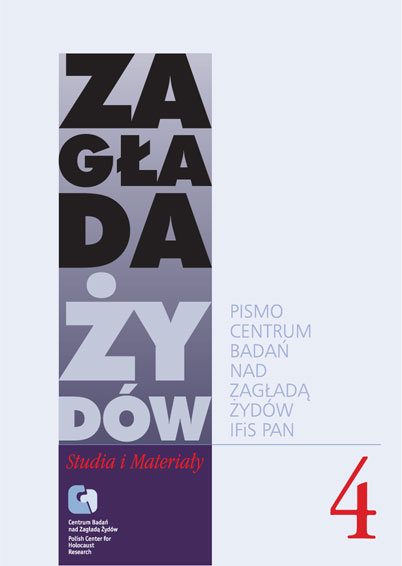
Not only about “Fear”. The psychology of the common understanding of history
Michał Bilewicz
redakcja@holocaustresearch.pl Author Biographypsycholog społeczny, koordynator Centrum Badań nad Uprzedzeniami przy Wydziale Psychologii Uniwersytetu Warszawskiego. Ostatnio opublikował "Być gorszymi. O reakcjach na zagrożenie statusu grupy własnej", Warszawa 2008. Zainteresowania badawcze: dehumanizacja, uprzedzenia, procesy tożsamości społecznej
 https://orcid.org/0000-0001-5027-1691
Center of Resarch on Prejudices, Department of Psychology, Warsaw University
Zagłada Żydów. Studia i Materiały, No. 4 (2008), Pages: 517-526
Submission Date: 2020-10-15Publication Date: 2008-11-02
 https://doi.org/10.32927/ZZSiM.288
Abstract
Publications on the Holocaust and the history of Polish-Jewish relations quite frequently lead to historical debates in the Polish media. On the one hand, it is a unique opportunity to publicise unknown pages of history, and on the other, a potential threat to contemporary Polish-Jewish relations. This article is an attempt to explain the Polish reactions to Jan Tomasz Gross’s Fear and the character of similar debates in Polish media. Thanks to the achievements of experimental social psychology (attribution errors, social identity theory, and the sleeper effect), we can now understand why certain books spawn a media debate while others do not; why the contents of the contested books reach the consciousness of a broader audience and why the debates that surround such books less and less resemble true discussion, in which people cease to talk to one another and engage in polemics against the position of their opponents.
License
Copyright (c) 2008 Author&"Holocaust Studies and Materials"

This work is licensed under a Creative Commons Attribution 4.0 International License.
https://creativecommons.org/licenses/by/4.0
The journal is published under the Diamond Open Access Standard, CC-BY-4.0 Deed - Attribution 4.0 International - Creative Commons
Most read articles by the same author(s)
- Marta Witkowska, Michał Bilewicz, Will the Truth Set Us Free?. Breaking the resistance in the education about Holocaust , Zagłada Żydów. Studia i Materiały: No. 10 (2014)
- Michał Bilewicz, Karolina Marcinkowska, The social psychology of the Holocaust: from naive situationism to understanding the role of ideology , Zagłada Żydów. Studia i Materiały: No. 20 (2024)
Similar Articles
- Aleksandra Bańkowska, Weronika Romanik, The Bialystok Ghetto Underground Archive. The Mersik–Tenenbaum Archive , Zagłada Żydów. Studia i Materiały: No. 9 (2013)
- Adam Puławski, Magdalena Hułas (red.), współpraca Piotr Długołęcki, Polskie Dokumenty Dyplomatyczne 1942 , Zagłada Żydów. Studia i Materiały: No. 20 (2024)
- Dan Michman, Dutch Society and the Jewish Fate: A Puzzling Record , Zagłada Żydów. Studia i Materiały: No. 12 (2016)
- Tomasz Żukowski, Jan Borowicz, Pamięć perwersyjna. Pozycje polskiego świadka Zagłady [Tomasz Żukowski] , Zagłada Żydów. Studia i Materiały: No. 17 (2021)
- Karolina Panz, Małgorzata Melchior, Nechama Tec , Zagłada Żydów. Studia i Materiały: No. 19 (2023)
- Jan Tomasz Gross, On Collaboration , Zagłada Żydów. Studia i Materiały: No. 2 (2006)
- Jan Borowicz, What Was Visible Immediately After the War? Forgotten 1940s Images of the Holocaust , Zagłada Żydów. Studia i Materiały: No. 17 (2021)
- Krzysztof Persak, What do we know today about German repressions for help to Jews? On the book Represje za pomoc Żydom na okupowanych ziemiach polskich w czasie II wojny światowej , Zagłada Żydów. Studia i Materiały: No. 16 (2020)
- Editors, Ewa Wiatr, Adam Sitarek, From the editors , Zagłada Żydów. Studia i Materiały: No. 16 (2020)
- Havi Dreifuss, Jewish Fighting Organization command during the Warsaw ghetto uprising – a new interpretation , Zagłada Żydów. Studia i Materiały: No. 19 (2023)
<< < 1 2 3 4 5 6 7 8 9 10 11 12 13 14 15 16 17 18 19 20 21 22 23 24 25 26 27 28 29 30 31 32 33 34 35 36 37 38 39 40 41 42 43 44 45 46 47 48 49 50 > >>
You may also start an advanced similarity search for this article.