English
 Język Polski


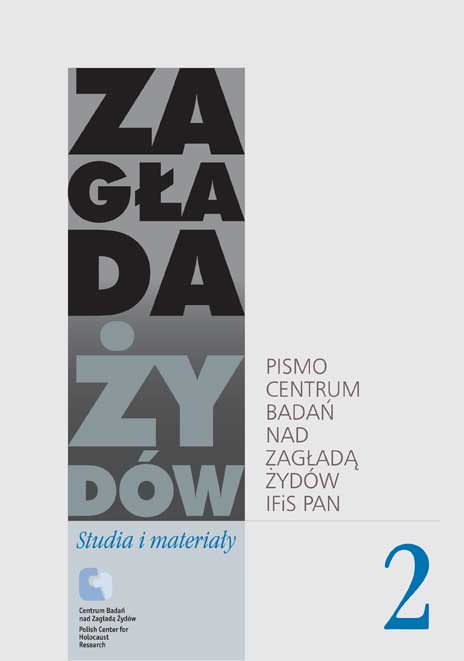
Jan Błoński „Poor Poles Look at the Ghetto” 20 Years Later
Zagłada Żydów. Studia i Materiały, No. 2 (2006), Pages: 12-20
Submission Date: 2020-10-11Publication Date: 2006-12-02
 https://doi.org/10.32927/ZZSiM.178
Abstract
The author reflects upon Jan Błoński’s essay “Biedni Polacy patrzą na getto” (Poor Poles look at the ghetto) nearly twenty years of its publication by Tygodnik Powszechny. He points at the innovative character of the depiction of Polish-Jewish issues in the moral context, outside of all the political embroilments. Błoński’s voice is unique, because it acknowledges, in the spirit of the Gospels, that analysis of Polish-Jewish relations is a fundamental issue for the Polish society, a “homework” that needs to be done. This essay, Głowiński claims, is free from the embroilment in the dualism of the negative and positive myths regarding these relations. The author writes about reactions to this text, the letters to the editor and notes one particular voice, which he reads as an internalised nationalist ideology and the dangerous continuation of the nationalist discourse. Głowiński’s sketch concludes the post scriptum, in which the
author refers to another article, published in 2006 by Gazeta Wyborcza, regarding the current historical policy, whose proponents see Błoński’s essay as a negative reference point. The author notes that this essay constantly evokes strong emotions, and, as an expression of critical patriotism, still has its ardent opponents.
License
Copyright (c) 2006 Author&"Holocaust Studies and Materials"

This work is licensed under a Creative Commons Attribution 4.0 International License.
https://creativecommons.org/licenses/by/4.0
The journal is published under the Diamond Open Access Standard, CC-BY-4.0 Deed - Attribution 4.0 International - Creative Commons
Most read articles by the same author(s)
- Michał Głowiński, Błoński’s Essay Years Later , Zagłada Żydów. Studia i Materiały: 2008: Holocaust Studies and Materials
- Michał Głowiński, Informer’s Eyes , Zagłada Żydów. Studia i Materiały: No. 10 (2014)
- Michał Głowiński, Batja Klig, Biography , Zagłada Żydów. Studia i Materiały: No. 7 (2011)
- Michał Głowiński, Mordechaj Chaim Rumkowski – real man and hero of the legend , Zagłada Żydów. Studia i Materiały: No. 9 (2013)
Similar Articles
- Maria Ferenc, Aleksandra Bańkowska, “Could there be any moral compensation for the obliteration of all traces of a thousand years of Jewish existence in Poland?” Unknown writings by Emanuel Ringelblum from 1943 , Zagłada Żydów. Studia i Materiały: No. 20 (2024)
- Antony Polonsky, Marian Turski in Memoriam , Zagłada Żydów. Studia i Materiały: No. 21 (2025)
- Justyna Kowalska-Leder, Polish Literature of the Last Decade about the Holocaust – Attempts to Face the New Challenges , Zagłada Żydów. Studia i Materiały: No. 10 (2014)
- Ewa Koźmińska-Frejlak, “I’m going to the oven because I didn’t want to give myself up.” Records of the Social Court of the Central Jewish in Poland. An attempt at a gender reading , Zagłada Żydów. Studia i Materiały: No. 19 (2023)
- Dariusz Libionka, Adam Kopciowski, The Life and the Holocaust in Hrubieszów in the Eyes of a Young Woman from Warsaw , Zagłada Żydów. Studia i Materiały: No. 3 (2007)
- Havi Dreifuss, Jewish Fighting Organization command during the Warsaw ghetto uprising – a new interpretation , Zagłada Żydów. Studia i Materiały: No. 19 (2023)
- Gabriel Finder, Bernard Mark, the Uprising in the Warsaw Ghetto, and Jürgen Stroop’s Trial , Zagłada Żydów. Studia i Materiały: No. 13 (2017)
- Yehuda Bauer, Nowogródek – the Story of a Shtetl , Zagłada Żydów. Studia i Materiały: No. 3 (2007)
- Anna Abakunkova, Contemporary Holocaust Studies in Ukraine , Zagłada Żydów. Studia i Materiały: No. 10 (2014)
- Jacek Leociak, Literature of the Personal Document as a Source in Holocaust Research (a Methodological Reconnaissance). , Zagłada Żydów. Studia i Materiały: 2008: Holocaust Studies and Materials
<< < 1 2 3 4 5 6 7 8 9 10 11 12 13 14 15 16 17 18 19 20 21 22 23 24 25 26 27 28 29 30 31 32 33 34 35 36 37 38 39 40 41 42 43 44 45 46 47 48 49 50 > >>
You may also start an advanced similarity search for this article.