English
 Język Polski

Distinct Profiles and Characteristics of Jewish and non-Jewish Concentration Camp Survivors in Sweden
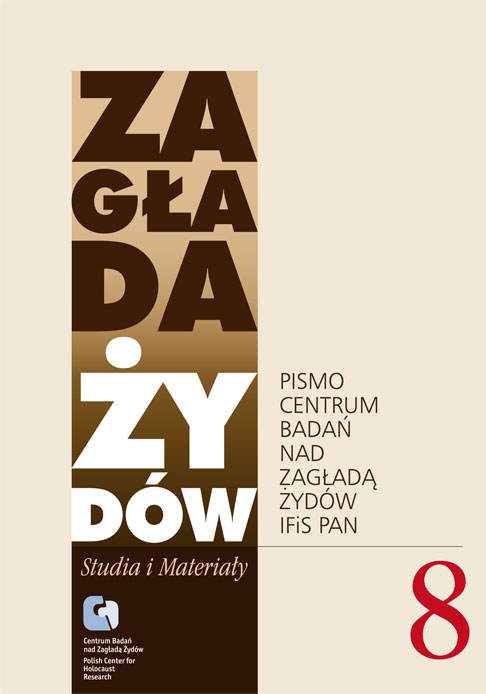
Zagłada Żydów. Studia i Materiały, No. 8 (2012), Pages: 419-429
Submission Date: 2020-12-06Publication Date: 2012-12-02
 https://doi.org/10.32927/zzsim.698
Abstract
Survivors from Nazi concentration camps, who were brought to Sweden as refugees during the last month of the Second World War and during the summer that followed, were often required to supply information about personal details to the authorities. Much of the information was later stored in written form in the Swedish National Archives. Antisemitism among the refugees and enmity between the Jewish and non-Jewish Polish refugees caused the authorities to include their ethnic or religious affiliation in many records and documents. Using mainly two collections from the Swedish National Archives it is shown that substantial differences existed between Jewish and non-Jewish Polish refugees with respect to their age, education and the length of their war experiences. These differences, in addition to the existing socio-geographic, demographic, cultural and ethnic differences led to inevitable clashes between the two groups. The Swedish authorities who first regarded all refugees of Polish citizenship as one national group had to revise this attitude gradually during the administration of the refugees
Keywords
Holocaust survivors , Sweden , Polish-Jewish relations
License
Copyright (c) 2012 Author&"Holocaust Studies and Materials"

This work is licensed under a Creative Commons Attribution 4.0 International License.
https://creativecommons.org/licenses/by/4.0
The journal is published under the Diamond Open Access Standard, CC-BY-4.0 Deed - Attribution 4.0 International - Creative Commons
Similar Articles
- Bartłomiej Krupa, Critical History and its “Shadow Cabinet.” Polish historiography on the Holocaust during 2003–2013 , Zagłada Żydów. Studia i Materiały: No. 10 (2014)
- Marta Duch-Dyngosz, In Search of Local Memory of the Holocaust. The Case of Commemoration of Jewish Communities in Smaller Towns in Contemporary Poland , Zagłada Żydów. Studia i Materiały: No. 17 (2021)
- Anna Cichopek-Gajraj, Joanna Tokarska-Bakir, Kocia muzyka. Historia chóralna pogromu krakowskiego, Warszawa: Czarna Owca, 2024, t. 1, 791 s., t. 2: Dokumenty, 1039 s. , Zagłada Żydów. Studia i Materiały: No. 21 (2025)
- Alina Skibinska, “Dangerous adventures and torments”. Relations of two women about how they survived the Holocaust on the territory of Bilgoraj county in the Lublin District , Zagłada Żydów. Studia i Materiały: No. 20 (2024)
- Havi Dreifuss, Jewish Fighting Organization command during the Warsaw ghetto uprising – a new interpretation , Zagłada Żydów. Studia i Materiały: No. 19 (2023)
- Dariusz Libionka, Polish Church Hierarchy and the Holocaust – an Essay from a Critical Perspective , Zagłada Żydów. Studia i Materiały: 2010: Holocaust Studies and Materials
- Gabriel Finder, Bernard Mark, the Uprising in the Warsaw Ghetto, and Jürgen Stroop’s Trial , Zagłada Żydów. Studia i Materiały: No. 13 (2017)
- Przemysław Czapliński, The Holocaust as a Horror. A Handful of Comments on Polish Literature during 1985–2015 , Zagłada Żydów. Studia i Materiały: No. 12 (2016)
- Jan Borowicz, What Was Visible Immediately After the War? Forgotten 1940s Images of the Holocaust , Zagłada Żydów. Studia i Materiały: No. 17 (2021)
- Ewa Koźmińska-Frejlak, “I’m going to the oven because I didn’t want to give myself up.” Records of the Social Court of the Central Jewish in Poland. An attempt at a gender reading , Zagłada Żydów. Studia i Materiały: No. 19 (2023)
<< < 1 2 3 4 5 6 7 8 9 10 11 12 13 14 15 16 17 18 19 20 21 22 23 24 25 26 27 28 29 30 31 32 33 34 35 36 37 38 39 40 41 42 43 44 45 46 47 48 49 50 > >>
You may also start an advanced similarity search for this article.