English
 Język Polski

Distinct Profiles and Characteristics of Jewish and non-Jewish Concentration Camp Survivors in Sweden
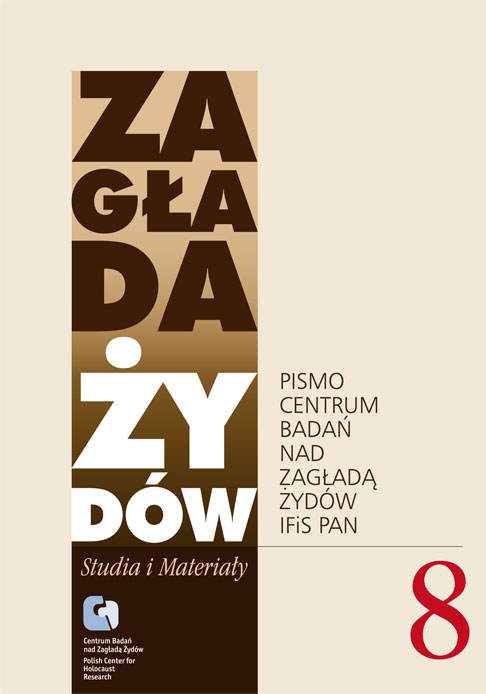
Zagłada Żydów. Studia i Materiały, No. 8 (2012), Pages: 419-429
Submission Date: 2020-12-06Publication Date: 2012-12-02
 https://doi.org/10.32927/zzsim.698
Abstract
Survivors from Nazi concentration camps, who were brought to Sweden as refugees during the last month of the Second World War and during the summer that followed, were often required to supply information about personal details to the authorities. Much of the information was later stored in written form in the Swedish National Archives. Antisemitism among the refugees and enmity between the Jewish and non-Jewish Polish refugees caused the authorities to include their ethnic or religious affiliation in many records and documents. Using mainly two collections from the Swedish National Archives it is shown that substantial differences existed between Jewish and non-Jewish Polish refugees with respect to their age, education and the length of their war experiences. These differences, in addition to the existing socio-geographic, demographic, cultural and ethnic differences led to inevitable clashes between the two groups. The Swedish authorities who first regarded all refugees of Polish citizenship as one national group had to revise this attitude gradually during the administration of the refugees
Keywords
Holocaust survivors , Sweden , Polish-Jewish relations
License
Copyright (c) 2012 Author&"Holocaust Studies and Materials"

This work is licensed under a Creative Commons Attribution 4.0 International License.
https://creativecommons.org/licenses/by/4.0
The journal is published under the Diamond Open Access Standard, CC-BY-4.0 Deed - Attribution 4.0 International - Creative Commons
Similar Articles
- Stanisław Krajewski, Discussing the Holocaust in Contemporary Poland , Zagłada Żydów. Studia i Materiały: No. 5 (2009)
- Monika Polit, Yankev Pat (1890–1966). “Jewish Brother from American Land Who is Also a Polish Jew” , Zagłada Żydów. Studia i Materiały: No. 16 (2020)
- Jacek Leociak, The Image of Poles in the Writings of Jews from the Warsaw District , Zagłada Żydów. Studia i Materiały: No. Holocaust Studies and Materials (2013)
- Jeffrey Kopstein, Jason Wittenberg, Neighborly violence, social science, and superficial similarities , Zagłada Żydów. Studia i Materiały: No. 21 (2025)
- Marta Tomczok, What is the Holocaust for Today, or Poetic Survival , Zagłada Żydów. Studia i Materiały: No. 17 (2021)
- Nawojka Cieślińska-Lobkowicz, Habent Sua Fata Libelli. Occupation-period art market in Warsaw and Jewish property , Zagłada Żydów. Studia i Materiały: No. 10 (2014)
- Sławomir Jacek Żurek, Lublin: Holocaust and remembrance. An analysis of Tomasz Pietrasiewicz’s Miasto odchodzi (The City is Departing) , Zagłada Żydów. Studia i Materiały: No. 21 (2025)
- Stephan Lehnstaedt, German Occupants in Warsaw and the Publicness of the Holocaust , Zagłada Żydów. Studia i Materiały: No. 12 (2016)
- Jan Grabowski, Barbara Engelking, Warsaw Jews Expelled from Switzerland to the General Government , Zagłada Żydów. Studia i Materiały: 2008: Holocaust Studies and Materials
- Maria Ferenc, “Understandably, we are staying put.” He-Chalutz activists faced with the prospect of escaping from occupied Poland , Zagłada Żydów. Studia i Materiały: No. 19 (2023)
<< < 1 2 3 4 5 6 7 8 9 10 11 12 13 14 15 16 17 18 19 20 21 22 23 24 25 26 27 28 29 30 31 32 33 34 35 36 37 38 39 40 41 42 43 44 45 46 47 48 49 50 > >>
You may also start an advanced similarity search for this article.