English
 Język Polski

Distinct Profiles and Characteristics of Jewish and non-Jewish Concentration Camp Survivors in Sweden
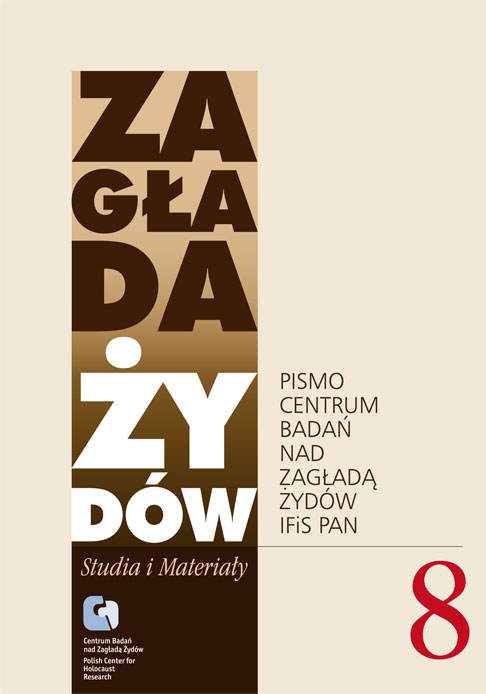
Zagłada Żydów. Studia i Materiały, No. 8 (2012), Pages: 419-429
Submission Date: 2020-12-06Publication Date: 2012-12-02
 https://doi.org/10.32927/zzsim.698
Abstract
Survivors from Nazi concentration camps, who were brought to Sweden as refugees during the last month of the Second World War and during the summer that followed, were often required to supply information about personal details to the authorities. Much of the information was later stored in written form in the Swedish National Archives. Antisemitism among the refugees and enmity between the Jewish and non-Jewish Polish refugees caused the authorities to include their ethnic or religious affiliation in many records and documents. Using mainly two collections from the Swedish National Archives it is shown that substantial differences existed between Jewish and non-Jewish Polish refugees with respect to their age, education and the length of their war experiences. These differences, in addition to the existing socio-geographic, demographic, cultural and ethnic differences led to inevitable clashes between the two groups. The Swedish authorities who first regarded all refugees of Polish citizenship as one national group had to revise this attitude gradually during the administration of the refugees
Keywords
Holocaust survivors , Sweden , Polish-Jewish relations
License
Copyright (c) 2012 Author&"Holocaust Studies and Materials"

This work is licensed under a Creative Commons Attribution 4.0 International License.
https://creativecommons.org/licenses/by/4.0
The journal is published under the Diamond Open Access Standard, CC-BY-4.0 Deed - Attribution 4.0 International - Creative Commons
Similar Articles
- Polish Center for Holocaust Research of the Institute of Philosophy and Sociology of the Polish Academy of Sciences, Polish Literature on Organized and Individual Help to the Jews (1945–2008) , Zagłada Żydów. Studia i Materiały: No. 4 (2008)
- Klara Jackl, “Is that me...” Henryk Beck’s pictorial memoir of the war and the Holocaust , Zagłada Żydów. Studia i Materiały: No. 20 (2024)
- Dariusz Libionka, Fight and Propaganda. The Uprising in the Warsaw Ghetto from the Perspective of the Polish Government in London , Zagłada Żydów. Studia i Materiały: No. 10 (2014)
- Zuzanna Schnepf-Kołacz , Polish Help to Jews in the Countryside during the German Occupation. A Sketch Using the Example of the Righteous among the Nations , Zagłada Żydów. Studia i Materiały: No. Holocaust Studies and Materials (2013)
- Dariusz Libionka, The Fighting and the Propaganda: The Uprising in the Warsaw Ghetto from the Perspective of ‘Polish London’ , Zagłada Żydów. Studia i Materiały: No. Holocaust Studies and Materials (2017)
- Barbara Engelking, “We are competely dependent on them...” – relations between the helpers and the hiding as exemplified by Fela Fischbein’s diary , Zagłada Żydów. Studia i Materiały: No. 4 (2008)
- Adam Puławski, Magdalena Hułas (red.), współpraca Piotr Długołęcki, Polskie Dokumenty Dyplomatyczne 1942 , Zagłada Żydów. Studia i Materiały: No. 20 (2024)
- Jacek Leociak, Stanislaw Sreniowski, From a Book of Madness And Atrocity , Zagłada Żydów. Studia i Materiały: 2008: Holocaust Studies and Materials
- Jan Grabowski, Tracking Emanuel Ringelblum. Participation of Polish Kriminalpolizei in the “Final Solution to the Jewish Question” , Zagłada Żydów. Studia i Materiały: No. 10 (2014)
- Katarzyna Odrzywołek, Piotr Trojański, Tehran Children – from Siberian Frost to Palestinian Sun. The role of Polish Embassy’s diplomatic posts in the USSR and Anders’s Army in rescuing Jewish children , Zagłada Żydów. Studia i Materiały: No. 11 (2015)
<< < 1 2 3 4 5 6 7 8 9 10 11 12 13 14 15 16 17 18 19 20 21 22 23 24 25 26 27 28 29 30 31 32 33 34 35 36 37 38 39 40 41 42 43 44 45 46 47 48 49 50 > >>
You may also start an advanced similarity search for this article.