English
 Język Polski


A Violin in Auschwitz
Maria Sławek
maria.slawek@amuz.krakow.pl Author Biographyviolinist, habilitated doctor of arts, works at the Department of Violin and Viola at the Krzysztof Penderecki Academy of Music in Kraków as an assistant professor; she runs his violin class there. Co-founder (with Ania Karpowicz) and president of the Mieczysław Weinberg Institute. The originator and coordinator of the International Conference "Mieczysław Wajnberg - Creator and History: Identity, Interpretations, Contexts", which took place at the Academy of Music in Krakow in 2019, curator of the project "Domówka u Mietka Wajnberga", co-curator of Spacerowik "Warszawa Wajnberga", initiator of the naming Mieczysław Weinberg street in Warsaw's Mirów district. She collaborates with "Ruch Muzyczny". She has three albums to her credit. She has performed in many Polish cities, as well as in Germany, Israel, Great Britain, Brazil, Belgium, Ukraine, USA, Italy and France.
 https://orcid.org/0000-0002-4228-1969
Krzysztof Penderecki Academy of Music in Krakow
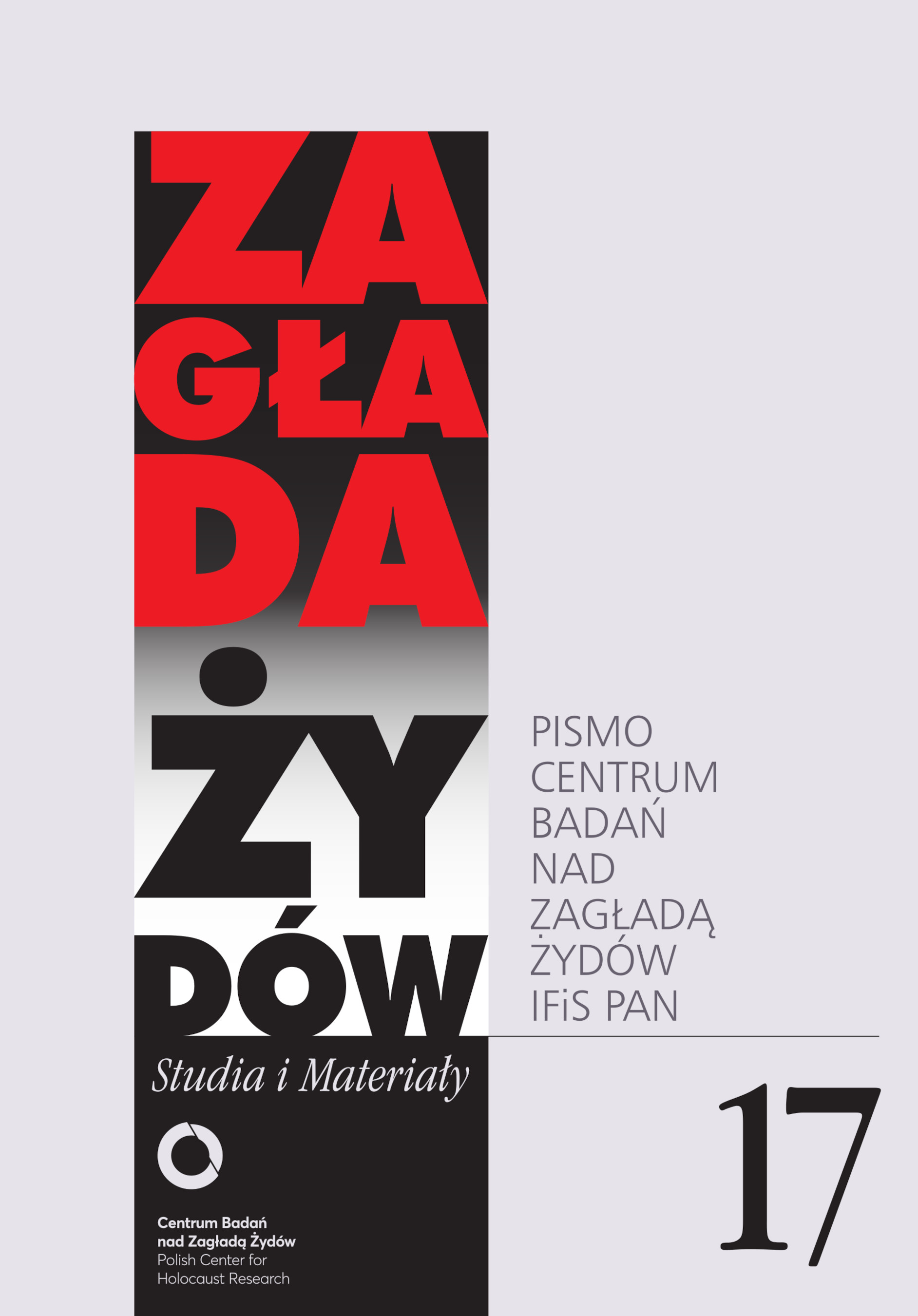
Zagłada Żydów. Studia i Materiały, No. 17 (2021), Pages: 629-630
Submission Date: 2021-12-19Publication Date: 2021-12-20
 https://doi.org/10.32927/zzsim.899
Abstract
In the music notation, a pause indicates the duration of the silence. Sometimes this silence is precisely dictated by the pace of the piece and the number of notes in the bar, in other cases it depends more on the inner sense of time of the player. It also happens that the composer writes down silence at the end of the piece, not trusting - perhaps rightly - the performer that he will be able to sense and understand it himself. Sometimes even the whole piece, as in the case of John Cage's famous 4'33, is actually written four and a half minutes of silence. Silence can be of great importance, it can be saturated with meanings or it can be completely empty.
Why am I writing about this?
...
Keywords
music in Auschwitz-Birkenau Museum
License
Copyright (c) 2021 Author&"Holocaust Studies and Materials"

This work is licensed under a Creative Commons Attribution 4.0 International License.
https://creativecommons.org/licenses/by/4.0
The journal is published under the Diamond Open Access Standard, CC-BY-4.0 Deed - Attribution 4.0 International - Creative Commons
Most read articles by the same author(s)
- Maria Sławek, Music as a form of commemoration of the Warsaw Ghetto Uprising , Zagłada Żydów. Studia i Materiały: No. 19 (2023)
Similar Articles
- Zofia Wóycicka, , Preserving the Decorum. The New Permanent Exhibition in the Museum and Memorial Site in Sobibór , Zagłada Żydów. Studia i Materiały: No. 17 (2021)
- Ewa Cuber-Strutyńska, Witold Pilecki. Confronting the legend of the “volunteer to Auschwitz” , Zagłada Żydów. Studia i Materiały: No. Holocaust Studies and Materials (2017)
- Justyna Matkowska, Piotr Setkiewicz, Sławomir Kapralski, Jerzy Dębski, Romowie i Sinti w KL Auschwitz, Oświęcim: Wydawnictwo Państwowego Muzeum Auschwitz-Birkenau, 2025, 388 s. , Zagłada Żydów. Studia i Materiały: No. 21 (2025)
- Caroline Sturdy Colls, Gone but not forgotten: Archaeological Approaches to the Site of the Former Treblinka Extermination Camp in Poland , Zagłada Żydów. Studia i Materiały: No. 8 (2012)
- Ewa Cuber-Strutyńska, Witold Pilecki. Confrontation with the legend of the “volunteer to Auschwitz” , Zagłada Żydów. Studia i Materiały: No. 10 (2014)
- Marian Turski, “Więcej nic nie powiem…” [I won’t say more...] - interview with Marian Turski, a Łódź ghetto survivor of 28 August 2019 on the eve of celebrations of the anniversary of Łódź ghetto liquidation , Zagłada Żydów. Studia i Materiały: No. 16 (2020)
- Stanisław Krajewski, Discussing the Holocaust in Contemporary Poland , Zagłada Żydów. Studia i Materiały: No. 5 (2009)
- Karolina Ożóg, “My life will begin on that day when I receive letters from you”. Correspondence of Jews who survived the Holocaust in the USSR and sought their relatives in Poland (1944–1945) , Zagłada Żydów. Studia i Materiały: No. 20 (2024)
- Katrin, One-Way Schedule. Interrogations of Former Reichsbahn Clerks Regarding the Deportation of Jews from Prużany to Auschwitz in 1943 , Zagłada Żydów. Studia i Materiały: No. 12 (2016)
- Maria Sławek, Music as a form of commemoration of the Warsaw Ghetto Uprising , Zagłada Żydów. Studia i Materiały: No. 19 (2023)
<< < 1 2 3 4 5 6 7 8 9 10 11 12 13 14 15 16 17 18 19 20 21 22 23 24 25 26 > >>
You may also start an advanced similarity search for this article.