English
 Język Polski


Documenting Responsibility. Jenő Lévai and the birth of Holocaust historiography in Hungary during the 1940s
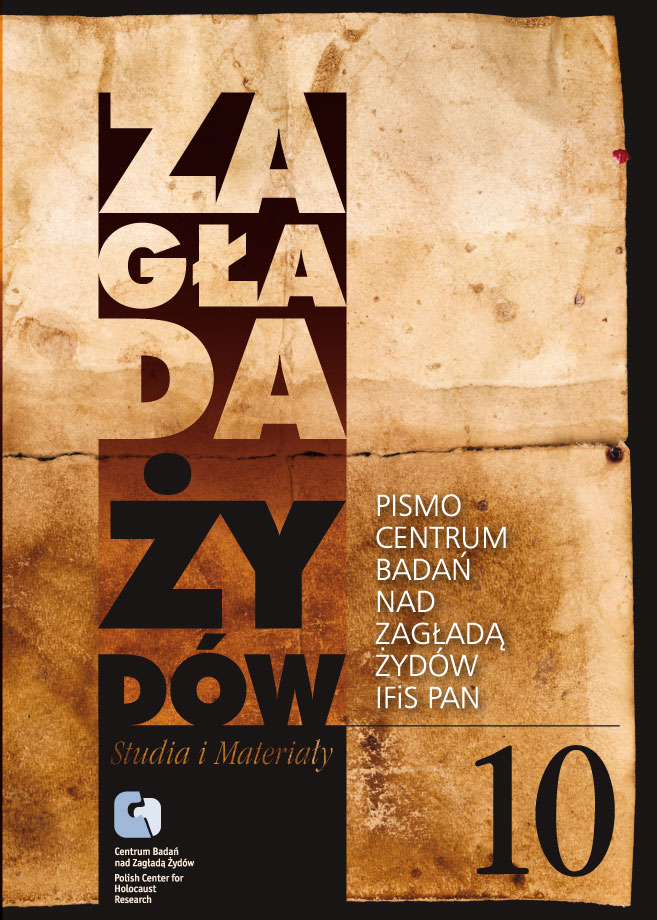
Zagłada Żydów. Studia i Materiały, No. 10 (2014), Pages: 354-383
Submission Date: 2020-10-22Publication Date: 2014-12-01
 https://doi.org/10.32927/ZZSiM.528
Abstract
The article aims at presentation, analysis, and evaluation of the achievements of Jenő Lévai, the precursor of the research on the Holocaust of Hungarian Jews. Modern cross-section works regarding Hungarian Jews are to a large extent based on his works, which at the same time are gradually losing their reputation as their value is being increasingly questioned, and that contrasts with the scale of his past achievements at the beginning of the post-war period. Laczó analyses Lévai’s key publications: Endre László. A háborús bűnösök magyar listavezetője (1945), which talks about the main Hungarian planner and executor of the Holocaust, Black Book of the Suffering of Hungarian Jewry (1946), which was the first study on the Holocaust in Hungary, A pesti gettó csodálatos megmenekülésének hiteles története [true history of a miraculous escape from the Pest ghetto] (1947) about the ghetto in Pest, and Lévai’s main synthesis Zsidósors Magyarországon [history of Jews in Hungary] (1948). The author concludes most controversy over Lévai’s studies is caused by the ideological interpretation they offer and Lévai’s tuning to the communists’ political goals.
License
Copyright (c) 2014 Author&"Holocaust Studies and Materials"

This work is licensed under a Creative Commons Attribution 4.0 International License.
https://creativecommons.org/licenses/by/4.0
The journal is published under the Diamond Open Access Standard, CC-BY-4.0 Deed - Attribution 4.0 International - Creative Commons
Similar Articles
- Aleksandra Ubertowska, The Comforting Power of Kitsch. The (Esthetic) Meanders of Holocaust Literature , Zagłada Żydów. Studia i Materiały: 2010: Holocaust Studies and Materials
- Przemysław Czapliński, The Auschwitz Virus , Zagłada Żydów. Studia i Materiały: No. Holocaust Studies and Materials (2017)
- Helena Datner, Marta Janczewska, Jacek Leociak, Archiwum Ringelbluma. Antologia , Zagłada Żydów. Studia i Materiały: No. 16 (2020)
- Nawojka Cieślińska-Lobkowicz, Traces of Unknown Pre-war Jewish Collectors and Owners of Works of Art , Zagłada Żydów. Studia i Materiały: No. 17 (2021)
- Adam Sitarek, Viktor Hahn’s Łódź ghetto diary , Zagłada Żydów. Studia i Materiały: No. 16 (2020)
- Maciej Kubicki, On a German Propaganda Film from the Warsaw Ghetto. An Analysis , Zagłada Żydów. Studia i Materiały: No. 2 (2006)
- Jan Grabowski, Klaus-Michael Mallmann, Martin Cüppers, Półksiężyc i swastyka. III Rzesza a świat arabski , Zagłada Żydów. Studia i Materiały: No. 5 (2009)
- Andrzej Żbikowski, Christopher Browning, The Origins of the Final Solution , Zagłada Żydów. Studia i Materiały: No. 1 (2005)
- Andrzej Żbikowski, August Grabski (red.), Pogromy Żydów na ziemiach polskich w XIX i XX wieku, t. 4: Holokaust i powojnie (1939–1946) , Zagłada Żydów. Studia i Materiały: No. 16 (2020)
- Dariusz Libionka, Remarks on rescuing Jews in the “vicinity of Treblinka” [review: Edward Kopówka, Father Paweł Rytel-Andrianik, I’ll Give Them a Name for Ages. Poles from around Treblinka Rescuing Jews] , Zagłada Żydów. Studia i Materiały: No. 9 (2013)
<< < 12 13 14 15 16 17 18 19 20 21 22 23 24 25 26 27 28 29 30 31 32 33 34 35 36 37 38 39 40 41 42 43 44 45 46 47 48 49 50 51 52 53 54 55 56 57 58 59 60 61 > >>
You may also start an advanced similarity search for this article.