English
 Język Polski

Holocaust Reception in Japan. Comparative Analysis: Auschwitz – Nanking – Hiroshima
Ariko Kato
redakcja@holocaustresearch.pl Author BiographyAssociate Professor na Uniwersytecie Studiów Międzynarodowych w Nagoji. Pracę doktorską na temat prozy i dzieł artystycznych Brunona Schulza obroniła na Uniwersytecie Tokijskim. Studiowała na Uniwersytecie Warszawskim jako stypendystka Fundacji Heiwa Nakajima i na Uniwersytecie Jagiellońskim jako stypendystka rządu polskiego. Jej zainteresowania obejmują międzywojenną literaturę i sztuki awangardowe, wielokulturowość w dawnej Galicji oraz reprezentacje Holokaustu i wojny w literaturze i sztuce. Po uzyskaniu grantu z Japan Society for the Promotion of Science w 2016–2017 była na stażu naukowym w Instytucie Badań Literackich PAN. Autorka książki „Bruno Schulz. Od oczu do rąk” (Tokio 2012; po japońsku) oraz licznych artykułów na temat Schulza. Redaktorka tomu antologii tekstów poświęconych Brunonowi Schulzowi pt. „Świat Brunona Schulza” (Yokohama 2013; po japońsku). Tłumaczyła na japoński m.in. Medaliony Zofii Nałkowskiej, utwory Debory Vogel i Andrzeja Stasiuka
 https://orcid.org/0000-0002-6298-4303
Nagoia International Relations University
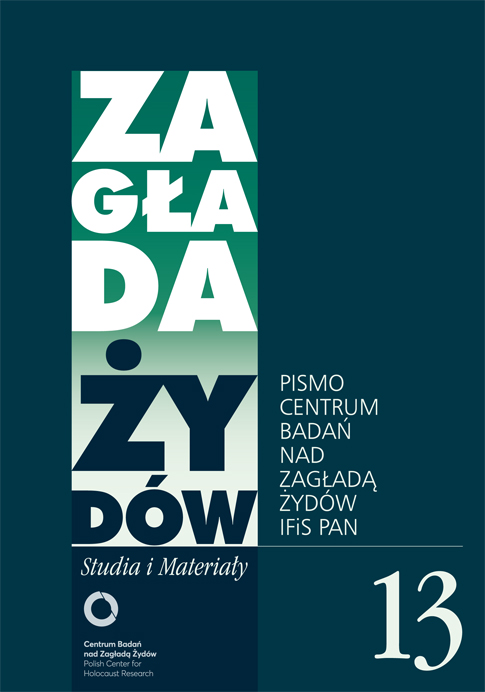
Zagłada Żydów. Studia i Materiały, No. 13 (2017), Pages: 230-257
Submission Date: 2020-10-17Publication Date: 2017-12-03
 https://doi.org/10.32927/ZZSiM.358
Abstract
This article attempts to present the reception of the Holocaust in relation to the topics of the atomic bombs and Japanese war crimes. Author’s comparative analysis revealed a number of shared issues regarding the war memory mechanisms, and also the characteristic style of Japanese narration centered on the key word ‘peace’. After the testimony period we are slowly entering the post-testimony era, when there will be no living witnesses. But it is also a period which enables researches to conduct a distanced analysis of the political and social discourse on war, particularly regarding Japan, whose post-war historical memory was built with the use of language of ambiguity and omissions. Using the comparative approach makes it possible not only to show the similarity of a number of issues regarding narration about the war, but it also conditions new narrations, which move beyond paradigms of national memory.
License
Copyright (c) 2017 Author&"Holocaust Studies and Materials"

This work is licensed under a Creative Commons Attribution 4.0 International License.
https://creativecommons.org/licenses/by/4.0
The journal is published under the Diamond Open Access Standard, CC-BY-4.0 Deed - Attribution 4.0 International - Creative Commons
Most read articles by the same author(s)
- Ariko Katō, Japanese Publications about the Holocaust Published After 1995 , Zagłada Żydów. Studia i Materiały: No. 14 (2018)
Similar Articles
- Jan Tomasz Gross, Perpetrators, Victims, and Others , Zagłada Żydów. Studia i Materiały: No. 10 (2014)
- Maria Ferenc, “Understandably, we are staying put.” He-Chalutz activists faced with the prospect of escaping from occupied Poland , Zagłada Żydów. Studia i Materiały: No. 19 (2023)
- Marta Tomczok, The Łódź Ghetto in Contemporary Literature for Children and Young People. Critique of ‘New Sensitivity’ , Zagłada Żydów. Studia i Materiały: No. 16 (2020)
- Joanna Bachura Wojtasik, How does radio remember the Warsaw Ghetto Uprising? About the anniversaries of the outbreak of the armed rebellion on the materials of radio journalism from the years 1945-1989. , Zagłada Żydów. Studia i Materiały: No. 19 (2023)
- Piotr Filipkowski, Between Oral History, Survival Psychology, and the Trauma of the Second Generation , Zagłada Żydów. Studia i Materiały: No. 11 (2015)
- Marta Tomczok, What is the Holocaust for Today, or Poetic Survival , Zagłada Żydów. Studia i Materiały: No. 17 (2021)
- Dariusz Libionka, Alina Skibińska, “I swear to fight for a free and mighty Poland, carry out the orders of my superiors, so help me God.”Jews in the Home Army. An Episode from Ostrowiec Świętokrzyski , Zagłada Żydów. Studia i Materiały: 2008: Holocaust Studies and Materials
- Nawojka Cieślińska-Lobkowicz, The new Holocaust Museum in Amsterdam , Zagłada Żydów. Studia i Materiały: No. 20 (2024)
- Klara Jackl, “Is that me...” Henryk Beck’s pictorial memoir of the war and the Holocaust , Zagłada Żydów. Studia i Materiały: No. 20 (2024)
- Adina Babeş, Publications and research on the Holocaust in Romania – The Elie Wiesel National Institute for Holocaust Research in Romania , Zagłada Żydów. Studia i Materiały: No. 8 (2012)
<< < 1 2 3 4 5 6 7 8 9 10 11 12 13 14 15 16 17 18 19 20 21 22 23 24 25 26 27 28 29 30 31 32 33 34 35 36 37 38 39 40 41 42 43 44 45 46 47 48 49 50 > >>
You may also start an advanced similarity search for this article.