English
 Język Polski


Hearsay in the Białystok Ghetto: A Contribution to Holocaust Historiography from the Jewish Perspective
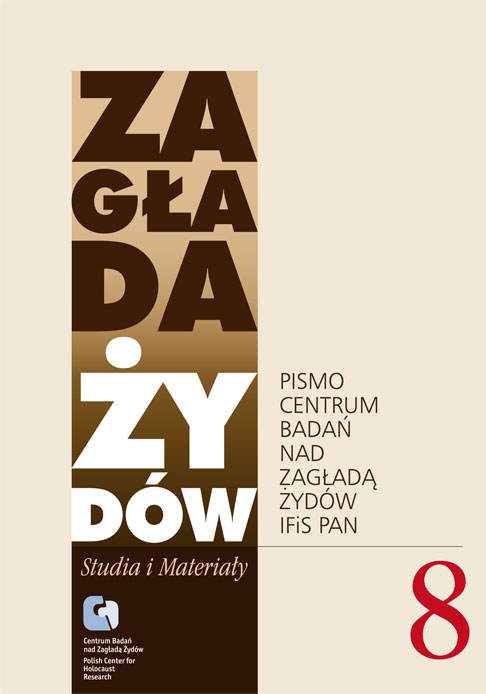
Zagłada Żydów. Studia i Materiały, No. 8 (2012), Pages: 214-236
Submission Date: 2020-10-28Publication Date: 2012-12-02
 https://doi.org/10.32927/ZZSiM.633
Abstract
The article deals with rumors, which were circulated in the Białystok ghetto. It seems that a rumor is a form of collective interpretation of reality whose function is to structure equivocal situations by explaining events or predicting them. The mood and behavior of individuals and groups may be influenced by rumors, in particular if they find themselves – as the Jews in the ghettos – in an exceptional and lifethreatening situation characterized by insecurity, isolation and uncertainty. The article analyzes rumors relating to the deportations of Jews from the ghetto and German mass murder actions. It addresses the following questions: Which impact did the different rumors have? How did the Judenrat and the ghetto population react to them? The article demonstrates that Jews acted upon their apprehension or misapprehension of events and that their subjective evaluation of the German extermination policy influenced their behavior and decisions
Keywords
rumors , deportations , German extermination policy , Judenrat , Jewish perspective and behavior
License
Copyright (c) 2012 Author&"Holocaust Studies and Materials"

This work is licensed under a Creative Commons Attribution 4.0 International License.
https://creativecommons.org/licenses/by/4.0
The journal is published under the Diamond Open Access Standard, CC-BY-4.0 Deed - Attribution 4.0 International - Creative Commons
Similar Articles
- Katarzyna Odrzywołek, Piotr Trojański, Tehran Children – from Siberian Frost to Palestinian Sun. The role of Polish Embassy’s diplomatic posts in the USSR and Anders’s Army in rescuing Jewish children , Zagłada Żydów. Studia i Materiały: No. 11 (2015)
- Maria Ferenc, Aleksandra Bańkowska, “Could there be any moral compensation for the obliteration of all traces of a thousand years of Jewish existence in Poland?” Unknown writings by Emanuel Ringelblum from 1943 , Zagłada Żydów. Studia i Materiały: No. 20 (2024)
- Karolina Panz, “Why did they, who had suffered so much and endured, had to die?” The Jewish victims of armed violence in Podhale (1945–1947) , Zagłada Żydów. Studia i Materiały: No. Holocaust Studies and Materials (2017)
- Tal Bruttmann, Anti-Jewish Policy, ‘Final Solution’, and Help Provided to Jews in Vichy France During 1940–1945 , Zagłada Żydów. Studia i Materiały: No. 11 (2015)
- Aleksandra Bańkowska, Jewish Social Self-help During Operation Reinhardt , Zagłada Żydów. Studia i Materiały: No. 13 (2017)
- Adam Sitarek, “Do Not Think That a Lunatic Is Writing This.” Letters of a Rabbi from Grabów and His Mission to Inform About the Holocaust , Zagłada Żydów. Studia i Materiały: No. 15 (2019)
- Zofia Wóycicka, Museum for adults. The New Exhibition in the Silent Heroes Memorial Center in Berlin , Zagłada Żydów. Studia i Materiały: No. 18 (2022)
- Martyna Grądzka-Rejak, Jan Olaszek, Stances and Behavior of Poles Towards Jews during the German Occupation as Presented in Underground Publications in Communist Poland , Zagłada Żydów. Studia i Materiały: No. 15 (2019)
- Grzegorz Rossoliński-Liebe, Ukrainian Police, Nationalism, and the Holocaust in Eastern Galicia and Volhynia , Zagłada Żydów. Studia i Materiały: No. 13 (2017)
- Pim Griffioen, Ron Zeller, Comparing the Persecution of the Jews in the Netherlands, France and Belgium, 1940-1945: Similarities, differences, causes , Zagłada Żydów. Studia i Materiały: No. 11 (2015)
<< < 1 2 3 4 5 6 7 8 9 10 11 12 13 14 15 16 17 18 19 20 21 22 23 24 25 26 27 28 29 30 31 32 33 34 35 36 37 38 39 40 41 42 43 44 45 46 47 48 49 50 > >>
You may also start an advanced similarity search for this article.