English
 Język Polski


Kicz i Holokaust, czyli pedagogiczny wymiar ekspozycji muzealnych
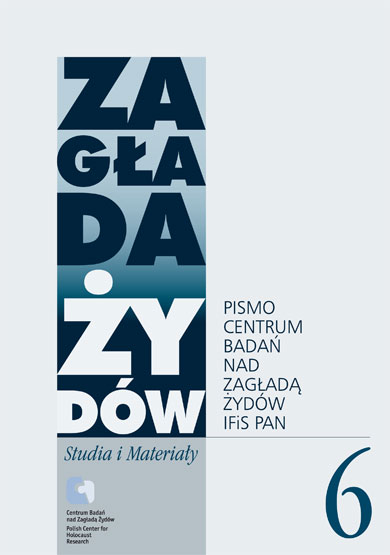
Zagłada Żydów. Studia i Materiały, No. 6 (2010), Pages: 74-86
Submission Date: 2020-12-06Publication Date: 2010-12-30
 https://doi.org/10.32927/zzsim.707
Abstract
Museum exbibition is a medium consisting of multiple media but the whole is something more that the sum of its parts. Each exhibition is a kind of spectacle, a specific cultural creation, and it works according to its own rules. An exhibition is also the core of museum experience and, as such, it should be subject to multidimensional analysis. Meanwhile, the content of an exhibition and the material used in its construction are often assessed, and very little is said about it as a form of expression and the specific character of its influence on the public. In the article I analyze the exhibition in the United States Holocaust Memorial Museum in Washington in terms of the kitsch category. The term itself is hardly precise and it is multidimensional. Therefore I define it for the purposes of the and test to what extent it can be used to interpret goals and principles of assumptions behind historical exhibition dedicated to the Holocaust. The article is an exemplary interpretation of exhibition’s poetics and policy and it aims at demonstrating how pedagogical functions of museum exhibitions about the Holocaust may reduce its dimension to a lesson on intolerance.
Keywords
Holocaust , representation , exhibition , kitsch , pedagogy
License
Copyright (c) 2010 Author&"Holocaust Studies and Materials"

This work is licensed under a Creative Commons Attribution 4.0 International License.
https://creativecommons.org/licenses/by/4.0
The journal is published under the Diamond Open Access Standard, CC-BY-4.0 Deed - Attribution 4.0 International - Creative Commons
Similar Articles
- John Pawlikowski OSM, The Catholic Church and the Holocaust; Institutional Persepectives , Zagłada Żydów. Studia i Materiały: No. 5 (2009)
- Marta Tomczok, What is the Holocaust for Today, or Poetic Survival , Zagłada Żydów. Studia i Materiały: No. 17 (2021)
- Boaz Tall, Trying Those who Cannot be Tried – Collaborator Trials in Israel , Zagłada Żydów. Studia i Materiały: No. 2 (2006)
- Maria Ferenc, Rebeca Clifford, Survivors: Children’s Lives After the Holocaust , Zagłada Żydów. Studia i Materiały: No. 19 (2023)
- Martin Dean, Economy of Exploitation: “Living Conditions” in the Ghettos of German-Occupied Eastern Poland , Zagłada Żydów. Studia i Materiały: No. 3 (2007)
- Tomasz Frydel, Ordinary Organization, Extraordinary State Violence: The Polish ‘Blue’ Police and the Holocaust in Eastern District Kraków , Zagłada Żydów. Studia i Materiały: No. 17 (2021)
- Dariusz Libionka, Alina Skibińska, “I swear to fight for a free and mighty Poland, carry out the orders of my superiors, so help me God.”Jews in the Home Army. An Episode from Ostrowiec Świętokrzyski , Zagłada Żydów. Studia i Materiały: 2008: Holocaust Studies and Materials
- Natalia Aleksiun, Historiography of the Holocaust on the Polish-Jewish relations in Poland , Zagłada Żydów. Studia i Materiały: No. 1 (2005)
- Adina Babeş, Publications and research on the Holocaust in Romania – The Elie Wiesel National Institute for Holocaust Research in Romania , Zagłada Żydów. Studia i Materiały: No. 8 (2012)
- Maria Ferenc, “Understandably, we are staying put.” He-Chalutz activists faced with the prospect of escaping from occupied Poland , Zagłada Żydów. Studia i Materiały: No. 19 (2023)
<< < 1 2 3 4 5 6 7 8 9 10 11 12 13 14 15 16 17 18 19 20 21 22 23 24 25 26 27 28 29 30 31 32 33 34 35 36 37 38 39 40 41 42 43 44 45 46 47 48 49 50 > >>
You may also start an advanced similarity search for this article.