English
 Język Polski


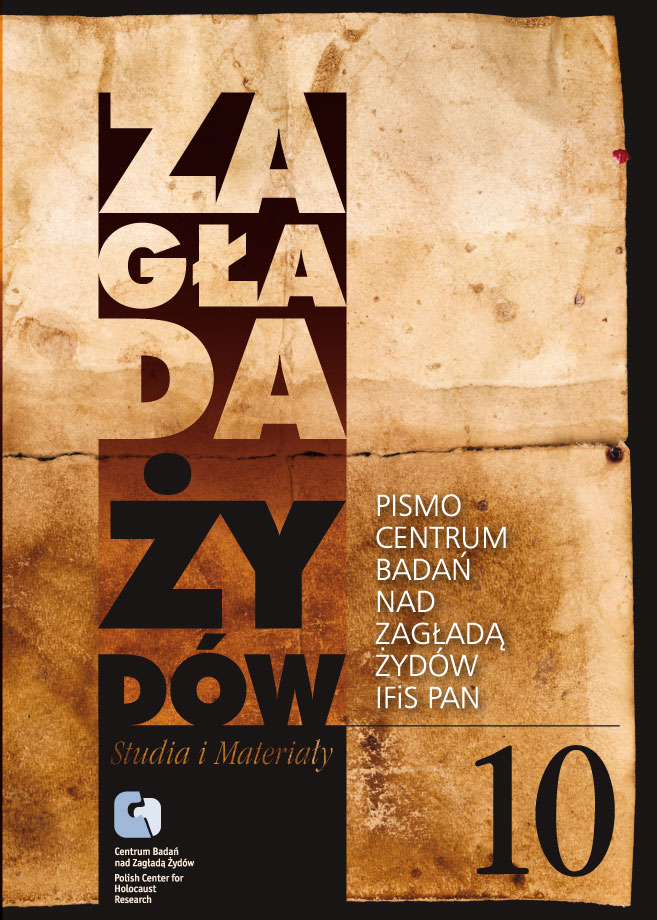
Will the Truth Set Us Free?. Breaking the resistance in the education about Holocaust
Marta Witkowska
redakcja@holocaustresearch.plMichał Bilewicz
bilewicz@psych.uw.edu.pl Author BiographySocial psychologist and sociologist. He works at the Department of Psychology at the Warsaw University, where he heads the Center for the Study of Prejudices. Works on the psychology of intergroup relations, particularly the contact hypothesis, dehumanization and stereotyping. In 2013, a special issue of the Journal of Social Issues, which he edited, was published on post-genocide reconciliation. He is currently conducting research on post-genocide reconciliation in Armenia, Turkey, Poland, Germany and Bosnia and Herzegovina.
 https://orcid.org/0000-0001-5027-1691
University of Warsaw, Department of Psychology
Zagłada Żydów. Studia i Materiały, No. 10 (2014), Pages: 803-822
Submission Date: 2020-10-26Publication Date: 2014-12-01
 https://doi.org/10.32927/ZZSiM.549
Abstract
The introduction of the programs on Holocaust education in Poland and a broader debate on the transgressions of Poles against the Jews have not led to desired improvement in public knowledge on these historical events. A comparison of survey results from the last two decades (Bilewicz, Winiewski, Radzik, 2012) illustrates mounting ignorance: the number of Poles who acknowledge that the highest number of victims of the Nazi occupation period was Jewish systematically decreases, while the number of those who think that the highest number of victims of the wartime period was ethnically Polish, increases. Insights from the social psychological research allow to explain the psychological foundations of this resistance to acknowledge the facts about the Holocaust, and indicate the need for positive group identity as a crucial factor preventing people from recognizing such a threatening historical information. In this paper we will provide knowledge about the ways to overcome this resistance-through-denial. Implementation of such measures could allow people to accept responsibility for the misdeeds committed by their ancestors.
License
Copyright (c) 2014 Author&"Holocaust Studies and Materials"

This work is licensed under a Creative Commons Attribution 4.0 International License.
https://creativecommons.org/licenses/by/4.0
The journal is published under the Diamond Open Access Standard, CC-BY-4.0 Deed - Attribution 4.0 International - Creative Commons
Most read articles by the same author(s)
- Michał Bilewicz, Not only about “Fear”. The psychology of the common understanding of history , Zagłada Żydów. Studia i Materiały: No. 4 (2008)
- Michał Bilewicz, Karolina Marcinkowska, The social psychology of the Holocaust: from naive situationism to understanding the role of ideology , Zagłada Żydów. Studia i Materiały: No. 20 (2024)
Similar Articles
- Dariusz Libionka, The Lublin Tower of Babel, or Dmowski on Jateczna Street , Zagłada Żydów. Studia i Materiały: No. 21 (2025)
- Dariusz Libionka, Entries Regarding Jews in the 1942–1944 Warsaw Police Chronicles , Zagłada Żydów. Studia i Materiały: No. 10 (2014)
- Marta Janczewska, Death in the German Official Language as Exemplified by Jürgen Stroop’s Report , Zagłada Żydów. Studia i Materiały: No. 12 (2016)
- Joanna Gubała-Czyżewska, Commemoration of Jewish Łódź: how the past manifests itself in the present , Zagłada Żydów. Studia i Materiały: No. 16 (2020)
- Justyna Kowalska-Leder, Polish Literature of the Last Decade about the Holocaust – Attempts to Face the New Challenges , Zagłada Żydów. Studia i Materiały: No. 10 (2014)
- Agnieszka Haska, “To Investigate and Reveal.” Central Jewish Historical Commission (1944–1947) , Zagłada Żydów. Studia i Materiały: No. 13 (2017)
- Nawojka Cieślińska-Lobkowicz, Jewish Biblia Pauperum , Zagłada Żydów. Studia i Materiały: No. 11 (2015)
- Jan Grabowski, Polish trust managers of Jewish property an outline of issues) , Zagłada Żydów. Studia i Materiały: No. 1 (2005)
- Marta Tomczok, What is the Holocaust for Today, or Poetic Survival , Zagłada Żydów. Studia i Materiały: No. 17 (2021)
- Feliks Tych, Barbara Engelking, About hidding on the Aryan side. Barbara Engelking talks with Feliks Tych , Zagłada Żydów. Studia i Materiały: No. 1 (2005)
<< < 1 2 3 4 5 6 7 8 9 10 11 12 13 14 15 16 17 18 19 20 21 22 23 24 25 26 27 28 29 30 31 32 33 34 35 36 37 38 39 40 41 42 43 44 45 46 47 48 49 50 > >>
You may also start an advanced similarity search for this article.