English
 Język Polski

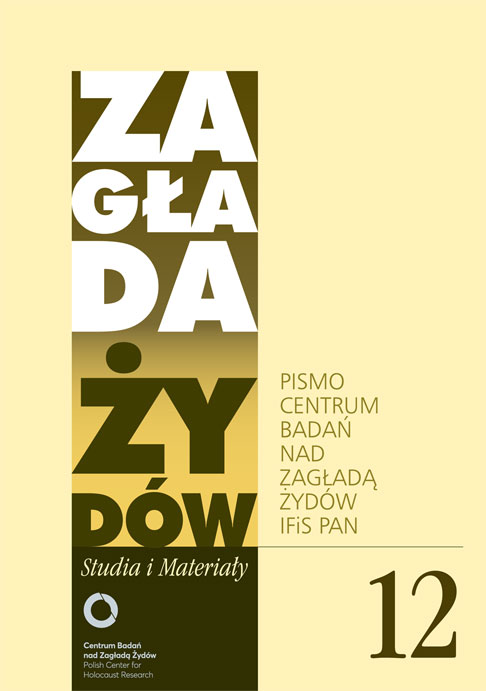
The Holocaust as a Horror. A Handful of Comments on Polish Literature during 1985–2015
Przemysław Czapliński
redakcja@holocaustresearch.pl Author BiographyPrzemysław Czapliński, full professor, 20th- and 21st-century literature historian, essayist, translator, literary critic, and co-founder of the Literary Anthropology Department of the Adam Mickiewicz University in Poznań. Research interests: 20thand 21st-century literature history, literary sociology and anthropology, literature of late Holocaust testimonies, oral literature, and 20th-century esthetics. He has written over 10 books; recently published Resztki nowoczesności (2011) and Poruszona mapa. Wyobraźnia geograficzno-kulturowa polskiej literatury przełomu XX i XXI wieku (2016); editor and co-editor of numerous collective publications – recently: Zagłada. Współczesne problemy rozumienia i przedstawiania (2009, together with Ewa Domańska), Jaka antropologia literatury jest dzisiaj możliwa (2010, together with Anna Legeżyńska and Marcin Jaworski), and Poetyka migracji. Doświadczenie granic w polskiej literaturze przełomu XX i XXI wieku (2013, together with Renata Makarska and Marta Tomczok). Together with Łukasz Zaremba he translated James English’s book The Economy of Prestige into Polish – Ekonomia prestiżu (2012).
 https://orcid.org/0000-0002-4805-6471
Adam Mickiewicz University in Poznań
Zagłada Żydów. Studia i Materiały, No. 12 (2016), Pages: 375-394
Submission Date: 2020-10-20Publication Date: 2016-11-30
 https://doi.org/10.32927/ZZSiM.423
Abstract
The author suggests that the depictions of the Holocaust in Polish literature of 1918–2014 should be categorized as horror. From the chronological perspective, Czapliński divides those thirty years into three shorter periods: 1) the initial period (from Claude Lanzmann’s Shoah and Jan Błoński’s essay “The Poor Poles Look at the Ghetto” to Wilhelm Dichter’s and Michał Głowiński’s memoirs) was dominated by white horror, which presented Jews as ghosts demanding a place in the Polish memory; 2) during the second period (from Marek Bieńczyk’s Tworki and Jan Tomasz Gross’ Neighbors until the end of the 2010s) the horror poetics was used to reveal those principles of pre-war and occupation-period normality which helped the Germans conduct the Holocaust and which conditioned the exclusion of Jews from the Polish circle of ‘normal humanity’; 3) during the third period (from Gross’s Golden Harvest until now) Jews return as the undead, violating the rules of distance and obliging Poles to physically touch the disgusting topic of the Holocaust. The contact with the Holocaust as something abhorring becomes a condition for self-knowledge, purging, and establishment of a new imaginary community.
License
Copyright (c) 2016 Author&"Holocaust Studies and Materials"

This work is licensed under a Creative Commons Attribution 4.0 International License.
https://creativecommons.org/licenses/by/4.0
The journal is published under the Diamond Open Access Standard, CC-BY-4.0 Deed - Attribution 4.0 International - Creative Commons
Most read articles by the same author(s)
- Przemysław Czapliński, The Auschwitz Virus , Zagłada Żydów. Studia i Materiały: No. Holocaust Studies and Materials (2017)
- Przemysław Czapliński, Truth and what's next , Zagłada Żydów. Studia i Materiały: No. 15 (2019)
- Przemysław Czapliński, Auschwitz Virus , Zagłada Żydów. Studia i Materiały: No. 10 (2014)
Similar Articles
- Jacek Leociak, O nadużyciach w badaniach nad doświadczeniem Zagłady , Zagłada Żydów. Studia i Materiały: No. 6 (2010)
- Marek Hłasko, Szukając gwaizd (Searching for the stars) , Zagłada Żydów. Studia i Materiały: No. 4 (2008)
- Alina Skibinska, Dariusz Libionka, “I swear to fight for a free and mighty Poland, carry out the orders of my superiors, so help me God.” Jews in the Home Army. An episode ..) , Zagłada Żydów. Studia i Materiały: No. 4 (2008)
- Martin Dean, David Cesarani, Final Solution: The Fate of the Jews 1933–1949 , Zagłada Żydów. Studia i Materiały: No. 13 (2017)
- Maria Ferenc, “Where is the Blessed Source, from Which He Drew his Power…” Memory of Mordechaj Anielewicz in Poland During 1943–1949 , Zagłada Żydów. Studia i Materiały: No. 18 (2022)
- Michał Borwicz, Monika Polit, Michał Borwicz, Josl Rakower Addresses God , Zagłada Żydów. Studia i Materiały: No. 3 (2007)
- Piotr Filipkowski, Post-Holocaust Oral History: Recordings, Archives, Methods of Reading , Zagłada Żydów. Studia i Materiały: No. 9 (2013)
- Yehuda Bauer, Nowogródek – the Story of a Shtetl , Zagłada Żydów. Studia i Materiały: No. 3 (2007)
- Tomáš Sniegoň, Recollection, History, Sense. The Subject Matter of the Holocaust against the Background of Post-War Events as Presented in Modern Czech Literature , Zagłada Żydów. Studia i Materiały: No. 10 (2014)
- Sharon Geva, Underground fighters, mothers and daughters. Jewish women in the Warsaw Ghetto during the uprising (April–May 1943) , Zagłada Żydów. Studia i Materiały: No. 19 (2023)
<< < 1 2 3 4 5 6 7 8 9 10 11 12 13 14 15 16 17 18 19 20 21 22 23 24 25 26 27 28 29 30 31 32 33 34 35 36 37 38 39 40 41 42 43 44 45 46 47 48 49 50 > >>
You may also start an advanced similarity search for this article.