English
 Język Polski

Censor Guarding the Church. Krystyna Modrzewska’s Censured Diary
Jacek Leociak
jleociak@gmail.com Author Biographylecturer in the Institute of Literary Studies of the Polish Academy of Sciences, head of the Holocaust Literature Studies Department of the Institute, member of the Polish Centre for Holocaust Research of the Institute of Philosophy and Sociology of the Polish Academy of Sciences. Co-author with Barbara Engelking The Warsaw Getto. A Guide to the Perished City (2009, Polish edition 2001)
 https://orcid.org/0000-0003-1471-6926
Institite of Literary Research of the Polish Academy of Sciences
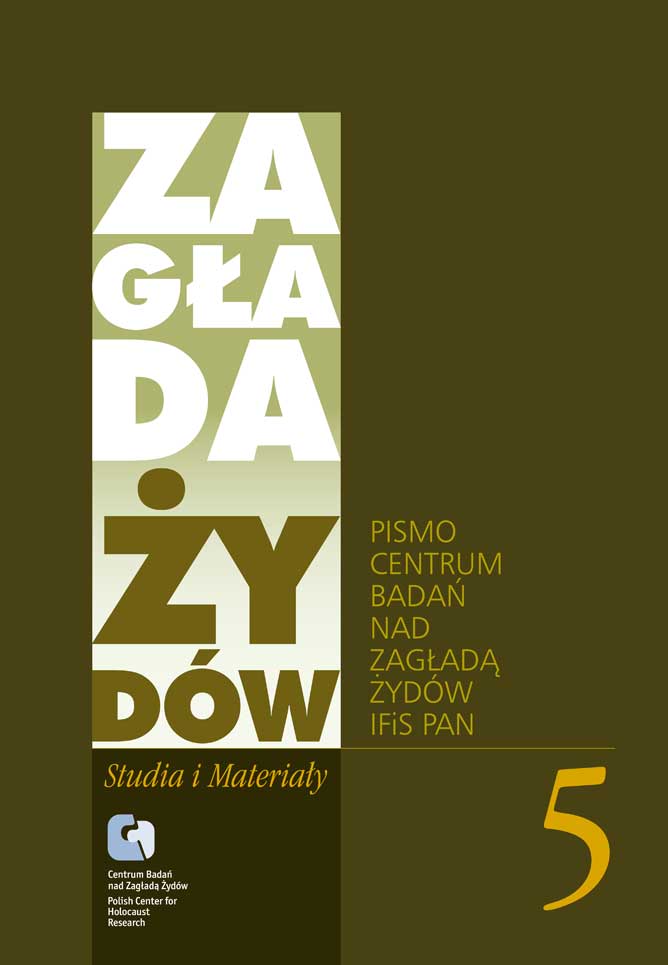
Zagłada Żydów. Studia i Materiały, No. 5 (2009), Pages: 371-393
Submission Date: 2020-10-17Publication Date: 2009-11-09
 https://doi.org/10.32927/ZZSiM.325
Abstract
In the three subsequent issues of The Bulletin of the Jewish Historical Institute of 1959 and 1960, the diary of Krystyna Modrzewska (Mendalbaum), submitted to the Central Jewish Historical Commission in 1947, was published. The first part, which opens with the outbreak of the war and ends with mass executions of the Jews in a forest near Krępiec, outside Lublin in spring 1942, was massacred by the censorship. The author writes, among other things, about hiding in the nunnery of the Congregation of Sisters of the Bethany Family outside Lublin, and she harshly judges the relations there. It turns out that the communist censor eliminated the record concerning critical views on the nuns’ mentality, their intellectual and moral standards. The censor did not approve of the comments about nunnery’s everyday life and church religious rituals, the clergy’s hypocrisy and the increasingly materialistic views of this group. The censor’s interference in the field of the author’s religious experience is even more acute as Modrzewska’s diary rates among a small group of testimonies describing adult Jews hiding in monasteries and convents. All those fragments has been restored in the current edition and placed in the context of the whole. Reading the integrated fragments of Modrzewska’s diary about hiding in the convent, it is worth pondering why a person (who had been baptized as a student of the university of Bologna, treating this ceremony very seriously, not opportunistically) experiences such a sheer disappointment in the convent near Lublin
License
Copyright (c) 2009 Author&"Holocaust Studies and Materials"

This work is licensed under a Creative Commons Attribution 4.0 International License.
https://creativecommons.org/licenses/by/4.0
The journal is published under the Diamond Open Access Standard, CC-BY-4.0 Deed - Attribution 4.0 International - Creative Commons
Most read articles by the same author(s)
- Jacek Leociak, Marta Tomczok, Affective Holocaust Kitsch – Introduction , Zagłada Żydów. Studia i Materiały: No. 17 (2021)
- Jacek Leociak, The Image of Poles in the Writings of Jews from the Warsaw District , Zagłada Żydów. Studia i Materiały: No. Holocaust Studies and Materials (2013)
- Dariusz Libionka, Jacek Leociak, 75th Anniversary of Operation Reinhardt , Zagłada Żydów. Studia i Materiały: No. 13 (2017)
- Jacek Leociak, Understanding the Holocaust. A Task for Generations , Zagłada Żydów. Studia i Materiały: 2008: Holocaust Studies and Materials
- Jacek Leociak, Literature of the Personal Document as a Source in Holocaust Research (a Methodological Reconnaissance). , Zagłada Żydów. Studia i Materiały: 2008: Holocaust Studies and Materials
- Karolina Sulej, Jacek Leociak, “He Smiled at Me and Sent Kisses with His Hand”. On Dora Sztatman’s testimony , Zagłada Żydów. Studia i Materiały: No. 5 (2009)
- Jacek Leociak, Literature of the Personal Document as a Source in Holocaust Research (a Methodological Reconnaissance) , Zagłada Żydów. Studia i Materiały: No. 1 (2005)
- Jacek Leociak, On the Abuses in Research of the Holocaust Experience , Zagłada Żydów. Studia i Materiały: 2010: Holocaust Studies and Materials
- Jacek Leociak, The Holocaust as Presented in the ‘Museum of Life’ (the POLIN Museum and its Problems with the Muranów Genius Loci) , Zagłada Żydów. Studia i Materiały: No. 11 (2015)
- Jacek Leociak, “I Did not Demand any Payment for the Aforementioned Memoirs.” How Władysław Wójcik Rescued Chaim Aron Kapłan’s Diary and the Ringelblum Archive , Zagłada Żydów. Studia i Materiały: No. 13 (2017)
Similar Articles
- Jacek Leociak, Anniversaries of the Warsaw Ghetto Uprising in public discourse (with special reference to the years 1943–1944, 1968 and 2023) , Zagłada Żydów. Studia i Materiały: No. 19 (2023)
- Urszula Grabowska, The Mariavites and the Jews – on help , Zagłada Żydów. Studia i Materiały: No. 4 (2008)
- Justyna Kowalska-Leder, The folk history of the Holocaust and the turn to oral history archives , Zagłada Żydów. Studia i Materiały: No. 21 (2025)
- Silvia Goldbaum Tarabini Fracapane, The Holocaust in Denmark – the victims in researchand memory , Zagłada Żydów. Studia i Materiały: No. 3 (2007)
- Anna Abakunkova, Contemporary Holocaust Studies in Ukraine , Zagłada Żydów. Studia i Materiały: No. 10 (2014)
- Barbara Engelking, “The Germans Have Killed Our Jews, So We’re Throwing Out”. The Case of Edward Toniakiewicz , Zagłada Żydów. Studia i Materiały: No. 10 (2014)
- Barbara Engelking, “Germans have killed our Jews, so we’re getting rid of them.” The case of Edward Toniakiewicz , Zagłada Żydów. Studia i Materiały: No. Holocaust Studies and Materials (2017)
- Jacek Leociak, Michał Głowinski , Zagłada Żydów. Studia i Materiały: No. 19 (2023)
- Monika Stolarczyk-Bilardie, “If the Holy See knew all these things in 1942, why did it not shout [them] out to the world?”The Vatican in the Face of the Holocaust: Information from Occupied Poland and its Reception by the Holy See, 1941−1943 , Zagłada Żydów. Studia i Materiały: No. 20 (2024)
- Stanisław Obirek, The Surprising Silence of the Polish Catholic Church after the Holocaust , Zagłada Żydów. Studia i Materiały: No. 15 (2019)
<< < 1 2 3 4 5 6 7 8 9 10 11 12 13 14 15 16 17 18 19 20 21 22 23 24 25 26 27 28 29 30 31 32 33 34 35 36 37 38 39 40 41 42 43 44 45 46 47 48 49 50 > >>
You may also start an advanced similarity search for this article.