English
 Język Polski


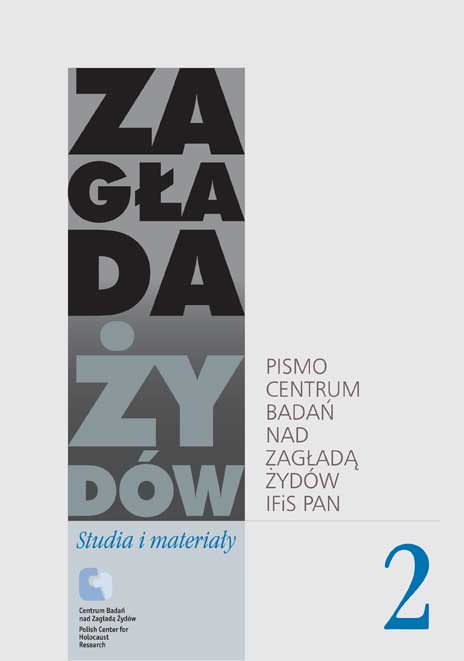
From Agent to Collaborator? The Collaboration of the Jewish Journalist Fritz Seifter of Bielsko with the German Authorities in the 1930s and the 1940s.
Zagłada Żydów. Studia i Materiały, No. 2 (2006), Pages: 163-176
Submission Date: 2020-10-11Publication Date: 2006-12-02
 https://doi.org/10.32927/ZZSiM.185
Abstract
Fritz Seifter, a Jewish-German journalist and Polish citizen, collaborated with the German authorities on two occasions: first during 1933–1934 in Bielsko, where, supported by the Reich Ministry of National Education and Propaganda, he launched his newspaper Jüdische Wochenpost; second, in July 1940, when the General Governor's Department of National Education and Propaganda in Cracow appointed him editor-in-chief and managing director of Gazeta Żydowska. But in either case the circumstances and motives for collaboration differed significantly.
In the case of Jüdische Wochenpost, Seifter completed a project he had been planning to carry out since the late 1920s. His newspaper was to consolidate the bonds of German-speaking Polish Jews with Germany. The Reich Ministry of National Education and Propaganda supported the establishment of this newspaper in order to tone down the opinions of Polish Jews regarding the Nazi regime in Berlin. During 1933–1934 Seifter saw himself as an agent of the German Ministry of Propaganda.
In 1940, German occupation authorities in Krakow searched for and found Fritz Seifter, who was to be appointed editor-in-chief and managing director for the German-planned Gazeta Żydowska, completely controlled by the Germans. Its principal aims were to isolate the Jews even further from their Polish environment, herd them to work and give illusions of hope for emigration after the war.
Thus there was no continuity in Seifter's co-operation with the German authorities, and collaboration was not the case. During 1933–1934, Seifter's main reason to launch his newspaper was German nationalism, which ostensibly linked him to the Germans. In 1940, however, Fritz Seifter no longer acted of his own accord, and any illusions as to the genocidal character of the Nazi regime was out of the question: Seifter alongside the rest of Polish Jews wanted only to survive.
Keywords
Friedrich Seifter , Poland , Polish-German relations , German-Jewish relations , newspaper , propaganda , national socialism , occupation , collaboration
License
Copyright (c) 2006 Author&"Holocaust Studies and Materials"

This work is licensed under a Creative Commons Attribution 4.0 International License.
https://creativecommons.org/licenses/by/4.0
The journal is published under the Diamond Open Access Standard, CC-BY-4.0 Deed - Attribution 4.0 International - Creative Commons
Similar Articles
- Krystyna Radziszewska, Department for the “Insettled” (Abteilung für die Eingesiedelte) in the Łódź Ghetto in Light of Archival Documents and Autobiographical Texts , Zagłada Żydów. Studia i Materiały: No. 16 (2020)
- Zofia Wóycicka, , Preserving the Decorum. The New Permanent Exhibition in the Museum and Memorial Site in Sobibór , Zagłada Żydów. Studia i Materiały: No. 17 (2021)
- Yehuda Bauer, The Warsaw Ghetto Rebellion in Perspective , Zagłada Żydów. Studia i Materiały: No. 14 (2018)
- Stanisław Obirek, The Surprising Silence of the Polish Catholic Church after the Holocaust , Zagłada Żydów. Studia i Materiały: No. 15 (2019)
- Boaz Tall, Trying Those who Cannot be Tried – Collaborator Trials in Israel , Zagłada Żydów. Studia i Materiały: No. 2 (2006)
- Feliks Tych, Barbara Engelking, About hidding on the Aryan side. Barbara Engelking talks with Feliks Tych , Zagłada Żydów. Studia i Materiały: No. 1 (2005)
- Ewa Wiatr, The Hakhshara Movement in the Łódź Ghetto in Light of Documents 1940–1941 , Zagłada Żydów. Studia i Materiały: No. 16 (2020)
- Gabriel Finder, Svenja Bethke, Dance on the Razor’s Edge:Crime and Punishment in the Nazi Ghettos [Gabriel N. Finder] , Zagłada Żydów. Studia i Materiały: No. 17 (2021)
- Dariusz Libionka, First Outline of the History of the Jewish Fighting Organization , Zagłada Żydów. Studia i Materiały: No. 9 (2013)
- Marta Tomczok, What is the Holocaust for Today, or Poetic Survival , Zagłada Żydów. Studia i Materiały: No. 17 (2021)
<< < 7 8 9 10 11 12 13 14 15 16 17 18 19 20 21 22 23 24 25 26 27 28 29 30 31 32 33 34 35 36 37 38 39 40 41 42 43 44 45 46 47 48 49 50 51 52 53 54 55 56 > >>
You may also start an advanced similarity search for this article.