English
 Język Polski


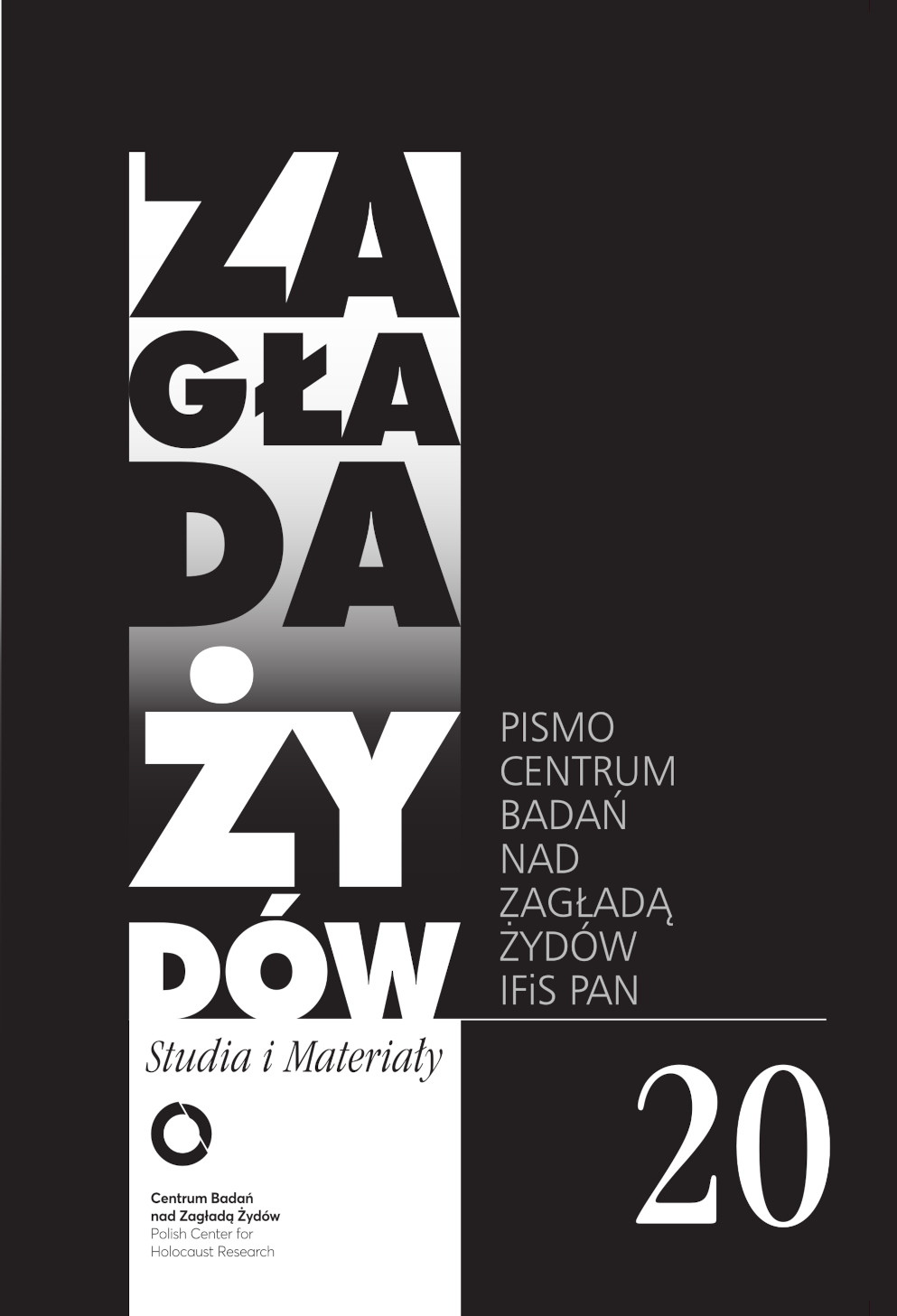
Emotions as testimony: Documenting the psychological aspects of witnessing in an early survivor historical commission
Victoria Van Orden Martínez
victoria.martinez@kultur.lu.se Author BiographyVictoria Van Orden Martínez – dr, pracuje jako badaczka na Uniwersytecie Lund w Szwecji. Pracę doktorską pt. „Afterlives: Jewish and Non-Jewish Polish Survivors of Nazi Persecution in Sweden Documenting Nazi Atrocities, 1945–56” obroniła w 2024 r. Jej badania koncentrują się głównie na życiu, działaniu i sprawczości ocalałych z nazistowskich prześladowań żyjących jako przesiedleńcy w pierwszych latach powojennych, ze specjalnym uwzględnieniem roli płci i innych różnic. Autorka artykułów w czasopismach szwedzkich i zagranicznych oraz rozdziałów w pracach zbiorowych, w tym tekstu Monuments cast shadows. Remembering and Forgetting the ‘Dead Survivors’ of Nazi Persecution in Swedish Cemeteries [w:] Fallen Monuments and Contested Memorials (z Malin Thor Tureby, 2023).
 https://orcid.org/0000-0003-4491-5520
Lund University, Sweden
Zagłada Żydów. Studia i Materiały, No. 20 (2024), Pages: 276-292
Submission Date: 2024-01-30Acceptance Date: 2024-07-10
Publication Date: 2024-12-17
 https://doi.org/10.32927/zzsim.1017
Abstract
In 1945–1946, nine Polish former prisoners of Nazi concentration camps (one Jewish and eight non-Jewish) living in Sweden as refugees were employed to record other Jewish and non-Jewish Poles’ experiences of persecution for history and justice. Although none of these individuals were psychologists, they believed recording the psychological aspects of witnessing was essential to their documentation work. The written testimonies they recorded, which are preserved in the archive of the Polish Research Institute in Lund, Sweden (PIZ), thus include revealing and often caring comments about the witnesses’ emotions and emotional responses during the interviews. I argue that this method made emotions integral to the testimonies and validated emotions as testimony. The significance of this argument is magnified when non-Jewish Poles interviewed Jewish Poles and vice versa since the comments reveal how they were relating to one another on a personal and sensitive level. This article builds on the author’s previous and ongoing analyses of these witness testimonies through close readings of the comments that consider the psychological aspects of witnessing. By contextualizing these comments and the testimonies they refer to alongside theories on the value of emotions for knowledge, the author explores what knowledge the method of recording witness testimonies contributed to creating in the early postwar period and what knowledge it creates now.
References
Żródła archiwalne / Archival sources
Google Scholar
Lund University Library (LUB), Sweden, The Polish Research Institute in Lund (PIZ) Archive
Google Scholar
Literatura przedmiotu / Studies
Google Scholar
Michael S. Brady, “Learning from Adversity: Suffering and Widsom,” Chapter 9 in The Value of Emotions for Knowledge, ed. Laura Candiotto, Switzerland: Palgrave Macmillan, 2019, pp. 197–214.
Google Scholar
Laura Candiotto, ed. The Value of Emotions for Knowledge, Switzerland: Palgrave Macmillan, 2019.
Google Scholar
Laura Candiotto, “Emotions In-Between: The Affective Dimension of Participatory Sense-Making,” Chapter 11 in The Value of Emotions for Knowledge, ed. Laura Candiotto, Switzerland: Palgrave Macmillan, 2019, pp. 235–260.
Google Scholar
Beth B. Cohen, “The Helping Process: Mental Health Professionals' Postwar Response to Survivors,” Chapter 7 in Case Closed: Holocaust Survivors in Postwar America, New Jersey: Rutgers University Press, 2007, pp. 133–54.
Google Scholar
Boaz Cohen, “The Children's Voice: Postwar Collection of Testimonies from Child Survivors of the Holocaust,” Holocaust and Genocide Studies, 21/1, pp. 73–95, https://doi.org/10.1093/hgs/dcm004.
Google Scholar
Marc-Antoine Crocq & Louis Crocq, “From shell shock and war neurosis to posttraumatic stress disorder: a history of psychotraumatology,” Dialogues in Clinical Neuroscience, 2/1, pp. 47–55, https://doi.org/10.31887/DCNS.2000.2.1/macrocq.
Google Scholar
Izabela A. Dahl, “Witnessing the Holocaust: Jewish Experiences and the Collection of the Polish Source Institute in Lund,” Chapter 3 in Early Holocaust Memory in Sweden: Archives, Testimonies and Reflections, eds. Johannes Heuman and Pontus Rudberg, Basingstoke & New York: Palgrave Macmillan, 2021, pp. 67–91.
Google Scholar
Paul Friedman, “The Road Back for the DPs: Healing the Psychological Scars of Nazism,” Commentary, December 1948.
Google Scholar
Eugeniusz Stanisław Kruszewski, Polski Instytut Żródłowy w Lund (1939-1972): Zarys historii i dorobek, Londyn; Kopenhaga: Polski Uniwersytet na Obczyźnie; Instytut Polsko-Skandynawski, 2001.
Google Scholar
Victoria Van Orden Martínez, Afterlives: Jewish and Non-Jewish Polish Survivors of Nazi Persecution in Sweden Documenting Nazi Atrocities, 1945–1946, Ph.D. diss., Linköping University, 2023.
Google Scholar
Victoria Van Orden Martínez, “Survivor-Refugee Humanitarianism: A New Perspective of Second World War Humanitarianism in Sweden,” Women and humanitarian aid - a historicizing perspective Conference, Örebro University, 2021.
Google Scholar
Victoria Van Orden Martínez, “Witnessing against a divide? An analysis of early Holocaust testimonies constructed in interviews between Jewish and non-Jewish Poles,” Holocaust Studies 28/4, pp. 483–505.
Google Scholar
Cecilea Mun, “How Emotions Know: Naturalizing Epistemology via Emotions,” Chapter 2 in The Value of Emotions for Knowledge, ed. Laura Candiotto, Switzerland: Palgrave Macmillan, 2019, pp. 27–50.
Google Scholar
Alan Rosen and Neal Lipsitz. “Oral Memoirs: The Testimony of Holocaust Survivors.” Oxford Research Encyclopedia of Psychology. 27 Aug. 2020, https://doi.org/10.1093/acrefore/9780190236557.013.480.
Google Scholar
Jerome Rosenberg, “Holocaust Survivors and Post-Traumatic Stress Disorders: The Need for Conceptual Reassessment and Development,” The Journal of Sociology & Social Welfare 11/4, pp. 930–938, https://doi.org/10.15453/0191-5096.1683.
Google Scholar
Paul Rudny, ”Zygmunt Lakocinski och polska källinstitutets arkiv i Lund 1939–87,” in Skandinavien och Polen. Möten, relationer och ömsesidig påverkan, ed. Barbara Törnquist-Plewa, Lund: Lund University Press, 2007, pp. 177–201.
Google Scholar
Murray B. Stein, and Barbara O. Rothbaum, “175 Years of Progress in PTSD Therapeutics: Learning from the Past,” The American Journal of Psychiatry, 175/6, pp. 508–516, https://doi.org/10.1176/appi.ajp.2017.17080955.
Google Scholar
Andrzej Nils Uggla, I nordlig hamn: Polacker i Sverige under andra världskriget, trans. Lennart Ilke. Uppsala: Centrum för multietnisk forskning, Uppsala Universitet, 1997.
Google Scholar
Netografia / Websites
Google Scholar
American Psychiatric Association, “What is Posttraumatic Stress Disorder (PTSD),” https://www.psychiatry.org/patients-families/ptsd/what-is-ptsd, last accessed 8 January 2024.
Google Scholar
Lund University Library (LUB) “Witnessing Genocide” digital archive: https://www.ub.lu.se/hitta/digitala-samlingar/witnessing-genocide, last accessed 6 January 2024.
Google Scholar
License
Copyright (c) 2024 Author&"Holocaust Studies and Materials"

This work is licensed under a Creative Commons Attribution 4.0 International License.
https://creativecommons.org/licenses/by/4.0
The journal is published under the Diamond Open Access Standard, CC-BY-4.0 Deed - Attribution 4.0 International - Creative Commons
Similar Articles
- Zuzanna Schnepf-Kołacz, The Fate of Journalists of the German ‘Reptile Newspaper’ – Nowy Kurier Warszawski in the Light of Post-War Trials on the Basis of the ‘August Decree’ , Zagłada Żydów. Studia i Materiały: No. 2 (2006)
- Alina Skibinska, “Dangerous adventures and torments”. Relations of two women about how they survived the Holocaust on the territory of Bilgoraj county in the Lublin District , Zagłada Żydów. Studia i Materiały: No. 20 (2024)
- Bartłomiej Krupa, Critical History and its “Shadow Cabinet.” Polish historiography on the Holocaust during 2003–2013 , Zagłada Żydów. Studia i Materiały: No. 10 (2014)
- Dariusz Libionka, Polish Church Hierarchy and the Holocaust – A Critical Essay , Zagłada Żydów. Studia i Materiały: No. 5 (2009)
- Stanislovas Stasiulis, Violeta Davoliūtė, Neighbors look to Neighbors. Debates over the Holocaust in Lithuania , Zagłada Żydów. Studia i Materiały: No. 21 (2025)
- Bartłomiej Krupa, Critical History and its ‘Shadow Cabinet’. Polish Historiography and the Holocaust during 2003–2013 , Zagłada Żydów. Studia i Materiały: No. Holocaust Studies and Materials (2017)
- Jacek Leociak, Literature of the Personal Document as a Source in Holocaust Research (a Methodological Reconnaissance) , Zagłada Żydów. Studia i Materiały: No. 1 (2005)
- Stephan Stach, "The spirit of the time left its stamp on these works." Writing the History of the Shoah at the Jewish Historical Institute in Stalinist Poland , Zagłada Żydów. Studia i Materiały: No. 13 (2017)
- Andrzej Żbikowski, Texts Buried in Oblivion. Testimonies of Two Refugees from the Mass Grave at Poniatowa , Zagłada Żydów. Studia i Materiały: 2008: Holocaust Studies and Materials
- Polish Center for Holocaust Research of the Institute of Philosophy and Sociology of the Polish Academy of Sciences, Polish Literature on Organized and Individual Help to the Jews (1945–2008) , Zagłada Żydów. Studia i Materiały: No. 4 (2008)
<< < 1 2 3 4 5 6 7 8 9 10 11 12 13 14 15 16 17 18 19 20 21 22 23 24 25 26 27 28 29 30 31 32 33 34 35 36 37 38 39 40 41 42 43 44 45 46 47 48 49 50 > >>
You may also start an advanced similarity search for this article.