English
 Język Polski


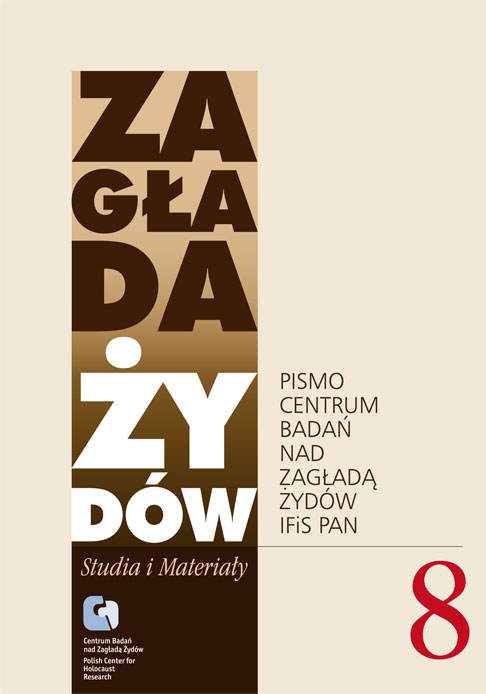
On the Clearing of the Post-Camp World. Ways of Handling the Human Remains at the Former KL Auschwitz-Birkenau Camp from the Final Evacuation to the
Marta Zawodna
redakcja@holocaustresearch.pl Author Biographyabsolwentka historii i socjologii na Uniwersytecie im. Adama Mickiewicza w Poznaniu, doktorantka w Instytucie Socjologii UAM. Pisze rozprawę doktorską na temat sposobów postępowania ze szczątkami ludzkimi w kulturze zachodniej
 https://orcid.org/0000-0002-0581-7197
Institute of Sociology, Adam Mickiewicz University in Poznań
Zagłada Żydów. Studia i Materiały, No. 8 (2012), Pages: 145-175
Submission Date: 2020-10-28Publication Date: 2012-12-02
 https://doi.org/10.32927/ZZSiM.630
Abstract
This article attempts to reconstruct the ways in which the living handled the human remains at KL Auschwitz-Birkenau from the final evacuation until the establishment of the museum. The first part of the text describes the appearance of the camp after the Germans had abandoned it leaving the bodies, bones and human ashes. It then reconstructs the following actions: collection of the corpses, removal of the dead from the hospital, inspection of the places where the human ashes were, autopsies, religious ceremonies undertaken by the former prisoners, Polish Red Cross volunteers, medical personnel, etc. The text shows that those actions resulted in a creation of a new post-camp order administered by the Polish and Soviet authorities, initially represented by the military men, the Polish Society of Former Political Prisoners (Polski Związek Byłych Więźniów Politycznych) and the Catholic Church. The last part of the article describes the way of handling the corpses which developed in opposition to the official practice. That alternative order was developed by those who looked for valuables in the former camp where the human remains were.
License
Copyright (c) 2012 Author&"Holocaust Studies and Materials"

This work is licensed under a Creative Commons Attribution 4.0 International License.
https://creativecommons.org/licenses/by/4.0
The journal is published under the Diamond Open Access Standard, CC-BY-4.0 Deed - Attribution 4.0 International - Creative Commons
Most read articles by the same author(s)
- Marta Zawodna , Shlomo Venezia, Sonderkommando. W piekle komór gazowych, przeł. Krystyna Szeżyńska-Maćkowiak, Prószyński i S-ka, przy współpracy z Państwowym Muzeum Auschwitz-Birkenau, Warszawa 2009 , Zagłada Żydów. Studia i Materiały: No. 6 (2010)
Similar Articles
- Ewa Cuber-Strutyńska, Witold Pilecki. Confronting the legend of the “volunteer to Auschwitz” , Zagłada Żydów. Studia i Materiały: No. Holocaust Studies and Materials (2017)
- Małgorzata Grzanka, “Besides, the despair of the people being deported was terrible; you could hear their crying, lamenting, and pleas.” The crime committed against Polish nursing home residents in Włocławek (spring–summer 1942) , Zagłada Żydów. Studia i Materiały: No. 21 (2025)
- Stanisław Krajewski, Discussing the Holocaust in Contemporary Poland , Zagłada Żydów. Studia i Materiały: No. 5 (2009)
- Michał Kowalski, Treblinka Penal Labor Camp I as Presented in Jewish Testimonies , Zagłada Żydów. Studia i Materiały: No. 18 (2022)
- Katarzyna Odrzywołek, Piotr Trojański, Tehran Children – from Siberian Frost to Palestinian Sun. The role of Polish Embassy’s diplomatic posts in the USSR and Anders’s Army in rescuing Jewish children , Zagłada Żydów. Studia i Materiały: No. 11 (2015)
- Heléna Huhák, András Szécsényi, Cavalcade of Interpretations: The Kasztner train Through the Self-narratives of the Fugitives , Zagłada Żydów. Studia i Materiały: No. 18 (2022)
- Justyna Kowalska-Leder, Fetishization of Authenticity – The Casus of the Museum and Memorial Site , Zagłada Żydów. Studia i Materiały: No. 17 (2021)
- Tadeusz Bartoś, Invariable Right to Great Death. Otto Kulka, Landscapes of the Metropolis of Death. Commentary , Zagłada Żydów. Studia i Materiały: No. 10 (2014)
- Justyna Matkowska, Piotr Setkiewicz, Sławomir Kapralski, Jerzy Dębski, Romowie i Sinti w KL Auschwitz, Oświęcim: Wydawnictwo Państwowego Muzeum Auschwitz-Birkenau, 2025, 388 s. , Zagłada Żydów. Studia i Materiały: No. 21 (2025)
- Ewa Cuber-Strutyńska, Witold Pilecki. Confrontation with the legend of the “volunteer to Auschwitz” , Zagłada Żydów. Studia i Materiały: No. 10 (2014)
<< < 1 2 3 4 5 6 7 8 9 10 11 12 13 14 15 16 17 18 19 20 21 22 23 24 25 26 27 28 > >>
You may also start an advanced similarity search for this article.