English
 Język Polski


Szaber Frenzy
Marcin Zaremba
redakcja@holocaustresearch.pl Author Biographyhistorian and sociologist, lecturer at the Institute of History of Warsaw University and the Institute of Political Studies of the Polish Academy of Sciences, recently published: “Jak nie urok, to... Strach przed czerwonoarmistami 1944-1947” in W objęciach wielkiego brata. Sowieci w Polsce 1944–1993, ed. Konrad Rokicki and Sławomir Stępień (Warsaw, 2009) and “The Myth of Ritual Murder in Post-War Poland: Pathology and Hypotheses”, Polin 23. Currently deals with social emotions, primarily fear in post-war Poland. Publishes in the Polityka weekly
 https://orcid.org/0000-0001-5036-1793
Institute of History, Warsaw University; Institute of Political Studies of the Polish Academy of Sciences
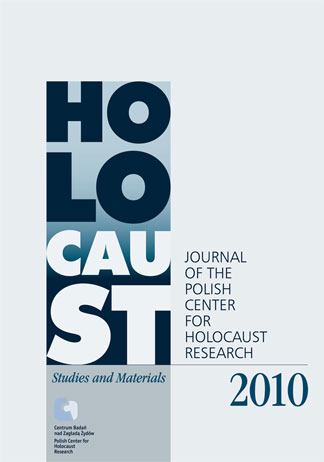
Zagłada Żydów. Studia i Materiały, 2010, Pages: 173-203
Submission Date: 2020-10-04Publication Date: 2010-11-30
 https://doi.org/10.32927/ZZSiM.124
Abstract
The subject of this article is war, and especially post-war, szaber – a phenomenon of mass looting of unattended property. The text is divided into three parts. In the first part, I attempt to explain theoretically the origin of szaber, indicating (among other things) its links with the culture of poverty and a necessary condition for the szaber to take place – a moment of chaos and a temporary decline of the power structures. In the second part, I formulate a hypothesis that ethnic difference was a necessary condition for szaber to emerge. I illustrate it with examples from September 1939, when first we faced a phenomenon of mass looting of unattended property. The article also deals with the pillage of the ghettos by Poles in 1942. The third part is devoted to the highest wave of looting, which took place mostly in the Regained Western and Northern Territories, immediately after the war. The text is constructed in such a way that at the end I return to the origin of the phenomenon, formulating a thesis that it created a certain szaber culture
Keywords
looting (szaber) , war chaos , culture of poverty , property pillage
License
Copyright (c) 2010 Author&"Holocaust Studies and Materials"

This work is licensed under a Creative Commons Attribution 4.0 International License.
https://creativecommons.org/licenses/by/4.0
The journal is published under the Diamond Open Access Standard, CC-BY-4.0 Deed - Attribution 4.0 International - Creative Commons
Most read articles by the same author(s)
- Marcin Zaremba, “That load of Jews is finally dead.” Extermination of Jews as presented in 1942 letters of German soldiers , Zagłada Żydów. Studia i Materiały: No. Holocaust Studies and Materials (2017)
- Marcin Zaremba, “That Entire Jewish Band Is Finally Dead.” Extermination of Jews as presented in 1942 letters of German soldiers , Zagłada Żydów. Studia i Materiały: No. 10 (2014)
- Marcin Zaremba, Looting Frenzy , Zagłada Żydów. Studia i Materiały: No. 5 (2009)
- Marcin Zaremba, CV of the Pogrom , Zagłada Żydów. Studia i Materiały: No. 14 (2018)
Similar Articles
- Justyna Kowalska-Leder, Three models of trust towards non-Jews on the Aryan side , Zagłada Żydów. Studia i Materiały: No. 20 (2024)
- Katarzyna Person, The Adventures of a Stamp Collector in the Warsaw Ghetto. Franz Konrad’s Story , Zagłada Żydów. Studia i Materiały: No. 7 (2011)
- Katarzyna Person, The Adventures of a Stamp Collector in the Warsaw Ghetto: Franz Konrad’s Story , Zagłada Żydów. Studia i Materiały: No. Holocaust Studies and Materials (2013)
- Adam Kopciowski, Pinkes Warsze - Warsaw Chronicle , Zagłada Żydów. Studia i Materiały: No. 10 (2014)
- Ariko Kato, Holocaust Reception in Japan. Comparative Analysis: Auschwitz – Nanking – Hiroshima , Zagłada Żydów. Studia i Materiały: No. 13 (2017)
- Boaz Tall, Trying Those who Cannot be Tried – Collaborator Trials in Israel , Zagłada Żydów. Studia i Materiały: No. 2 (2006)
- Agnieszka Haska, Yorai Linenberg, Jewish Soldiers in Nazi Captivity: American and British Prisoners of War during the Second World War , Zagłada Żydów. Studia i Materiały: No. 20 (2024)
- Andrew Kornbluth, „There Are Many Cains Among Us” [Jest wielu Kainów pośród nas]: Polish Justice and the Holocaust, 1944–1956 , Zagłada Żydów. Studia i Materiały: No. 9 (2013)
- Jacek Walicki, The Archive Department of the Łódź ghetto and the Ringelblum Archive , Zagłada Żydów. Studia i Materiały: No. 16 (2020)
- Agnieszka Witkowska-Krych, Janusz Korczak’s Ghetto Diary and War-Time Sources from Korczak’s Orphanage. How Did They Survive? , Zagłada Żydów. Studia i Materiały: No. 8 (2012)
<< < 1 2 3 4 5 6 7 8 9 10 11 12 13 14 15 16 17 18 19 20 21 22 23 24 25 26 27 28 29 30 31 32 33 34 35 36 37 38 39 40 41 > >>
You may also start an advanced similarity search for this article.