English
 Język Polski


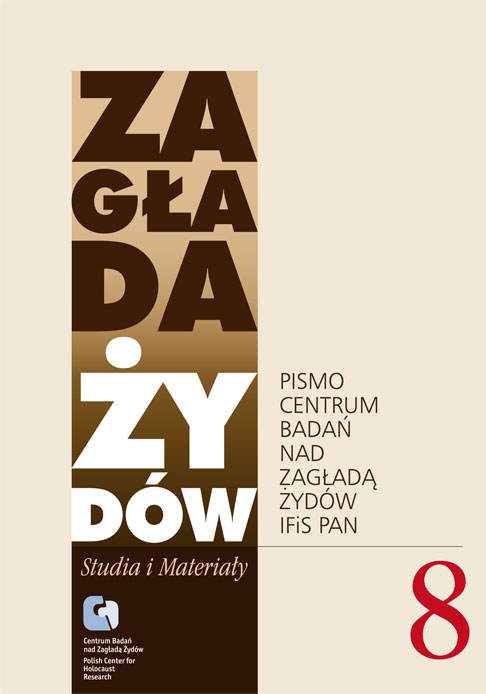
Gone but not forgotten: Archaeological Approaches to the Site of the Former Treblinka Extermination Camp in Poland
Caroline Sturdy Colls
redakcja@holocaustresearch.pl Author Biographydoktor, wykłada na Uniwersytecie Staffordshire. Specjalizuje się w archeologii Zagłady i archeologii sądowej. Zakończyła pierwszą fazę badań archeologicznych w byłym obozie zagłady Treblinka oraz w miejscach powiązanych z programem pracy niewolniczej w Alderney (Wyspy Normandzkie) i w byłym obozie dla Żydów (następnie Anhaltelager) Semlin pod Belgradem.
 https://orcid.org/0000-0003-2942-6219
Staffordshire University
Zagłada Żydów. Studia i Materiały, No. 8 (2012), Pages: 83-118
Submission Date: 2020-10-27Publication Date: 2012-12-02
 https://doi.org/10.32927/ZZSiM.628
Abstract
Public impression of the Holocaust is unquestionably centred on knowledge about, and the image of, Auschwitz-Birkenau – the gas chambers, the crematoria, the systematic and industrialized killing of victims. Conversely, knowledge of the former extermination camp at Treblinka, which stands in stark contrast in terms of the visible evidence that survives pertaining to it, is less embedded in general public consciousness. As this paper argues, the contrasting level of knowledge about Auschwitz- Birkenau and Treblinka is centred upon the belief that physical evidence of the camps only survives when it is visible and above-ground. The perception of Treblinka as having been “destroyed” by the Nazis, and the belief that the bodies of all of the victims were cremated without trace, has resulted in a lack of investigation aimed at answering questions about the extent and nature of the camp, and the locations of mass graves and cremation pits. This paper discusses the evidence that demonstrates that traces of the camp do survive. It outlines how archival research and non-invasive archaeological survey has been used to re-evaluate the physical evidence pertaining to Treblinka in a way that respects Jewish Halacha Law. As well as facilitating spatial and temporal analysis of the former extermination camp, this survey has also revealed information about the cultural memory.
Keywords
Treblinka , Holocaust archaeology , extermination camp , physical evidence , Jewish Halacha law
License
Copyright (c) 2012 Author&"Holocaust Studies and Materials"

This work is licensed under a Creative Commons Attribution 4.0 International License.
https://creativecommons.org/licenses/by/4.0
The journal is published under the Diamond Open Access Standard, CC-BY-4.0 Deed - Attribution 4.0 International - Creative Commons
Most read articles by the same author(s)
- Caroline Sturdy Colls, Gone but not Forgotten: Archaeological approaches to the site of the former Treblinka Extermination Camp in Poland , Zagłada Żydów. Studia i Materiały: No. Holocaust Studies and Materials (2013)
Similar Articles
- Editors, From the editors , Zagłada Żydów. Studia i Materiały: No. 8 (2012)
- Michał Czajkowski, Wartime Jesuit , Zagłada Żydów. Studia i Materiały: No. 13 (2017)
- Editors, From the editors , Zagłada Żydów. Studia i Materiały: No. 3 (2007)
- Renata Piątkowska, Jewish Museum and Tolerance Center in Moscow , Zagłada Żydów. Studia i Materiały: No. 9 (2013)
- Marcin Napiórkowski, Paweł Dobrosielski, Forgiveness as a Category of Modern Memory Discourse as Seen in Jarosław Marek Rymkiewicz’s Kinderszenen and Simon Wiesenthal’s The Sunflower: On the Possibilities and Limits of Forgiveness , Zagłada Żydów. Studia i Materiały: No. 7 (2011)
- Dariusz Libionka, Encyclopedia of Camps and Ghettos 1933–1945, t. 2: Ghettos in German-Occupied Eastern Europe , Zagłada Żydów. Studia i Materiały: No. 9 (2013)
- Zuzanna Schnepf-Kołacz, The Italian Garden of History. Rome, Ferrara, Milan – New Projects on the Map of Jewish Museums in Italy , Zagłada Żydów. Studia i Materiały: No. 9 (2013)
- Helena Datner-Śpiewak, Antisemitism And Its Opponents In Modern Poland , Zagłada Żydów. Studia i Materiały: No. 2 (2006)
- Robert Szuchta, Piotr Trojański, How to Wrote Textbooks on the Holocaust? Notes on the Review of Zrozumieć Holokaust , Zagłada Żydów. Studia i Materiały: No. 9 (2013)
- Adam Puławski, Remarks and Reflections on the Educational Publication Zrozumieć Holokaust [To Understand the Holocaust] , Zagłada Żydów. Studia i Materiały: No. 9 (2013)
<< < 46 47 48 49 50 51 52 53 54 55 56 57 58 59 60 61 62 63 64 65 66 67 68 69 70 71 72 73 74 75 76 77 > >>
You may also start an advanced similarity search for this article.